
Employee stock options are a common form of compensation at private companies, especially startups and growing technology businesses. They give employees the opportunity to purchase company shares at a predetermined price, known as the exercise price or strike price.
Unlike publicly traded stock options, private company stock options generally cannot be sold on an open stock exchange. Employees may have to wait for an acquisition, initial public offering (IPO), company-approved secondary sale, or another liquidity event before they can turn their shares into cash.
Private company stock options give employees the right, but not the obligation, to purchase company shares at a predetermined price. Employees typically earn the right to exercise options through a vesting schedule. Their potential financial benefit depends on the company’s future share value, exercise costs, tax obligations, and ability to provide liquidity.
For example, suppose a startup grants an employee 5,000 stock options with an exercise price of $2 per share. If the company eventually becomes worth more and its shares reach $15, the employee may have an opportunity to purchase shares below their estimated market value.
However, the employee must first satisfy the vesting requirements, pay the exercise cost, understand the tax consequences, and consider whether the shares can actually be sold.
This guide explains how private company stock options work in the United States, including vesting, exercising, ISO and NSO taxation, 409A valuations, liquidity restrictions, and the financial risks employees should understand before accepting or exercising an award.
1. What Are Private Company Stock Options?
Private company stock options are contractual rights granted by an employer that allow eligible employees or other service providers to purchase company shares at a specified price during a defined period.
The company does not immediately give the employee ownership of the shares when it grants an option.
Instead, the employee receives the right to purchase a certain number of shares after satisfying the conditions established in the stock option plan and individual grant agreement.
For example:
- Company: ABC Technologies Inc.
- Employee: Startup software engineer.
- Options granted: 5,000.
- Exercise price: $2 per share.
- Vesting period: Four years.
- Cliff period: One year.
- Option expiration: Ten years after grant, subject to the agreement and applicable law.
The employee may eventually have the right to purchase all 5,000 shares for $10,000.
However, receiving the option grant does not mean those shares are immediately owned or that they are worth $75,000.
The employee must consider the company’s actual share value, dilution, restrictions, and potential liquidity.
Why Do Private Companies Offer Stock Options?
Private companies use stock options to attract and retain employees while conserving cash.
Startups may not have the financial resources to offer salaries comparable to established companies. Equity compensation gives employees an opportunity to participate in potential future company growth.
Common reasons companies offer stock options include:
- Attracting experienced employees.
- Retaining employees over several years.
- Rewarding long-term contributions.
- Aligning employee and shareholder interests.
- Conserving cash during early growth stages.
- Encouraging employees to contribute to company performance.
However, stock options are not guaranteed compensation. Their value depends on future company performance and the terms of the award.
2. How Do Private Company Stock Options Work?
The stock option process generally involves six stages.
Private Company Stock Option Lifecycle
- Option grant
The company awards the employee a specified number of options with an exercise price. - Vesting period
The employee earns the right to exercise options over time by meeting service or performance requirements. - Exercise decision
The employee decides whether to purchase vested shares by paying the exercise price. - Share ownership
Following a valid exercise and issuance, the employee becomes a shareholder, subject to applicable restrictions. - Liquidity event
The company may eventually provide an opportunity to sell shares through an IPO, acquisition, or approved secondary transaction. - Tax reporting
The employee reports applicable compensation income, capital gains, or other tax consequences.
The important distinction is that an option grant, vesting event, exercise transaction, and share sale are separate events.
An employee may have fully vested options without exercising them. They may also exercise options and own private shares without being able to sell those shares immediately.
This is why employees should understand the entire lifecycle instead of focusing only on the number of options included in their offer letter.
3. What Is a Stock Option Vesting Schedule?
A vesting schedule determines when an employee earns the right to exercise granted stock options.
Most private companies use time-based vesting, although some awards also include performance conditions.
A common startup arrangement is four-year vesting with a one-year cliff.
Four-Year Vesting With a One-Year Cliff
Suppose a startup grants an employee 4,800 stock options.
The company uses a four-year vesting schedule with a one-year cliff and monthly vesting afterward.
The schedule might look like this:
| Employment period | Newly vested options | Cumulative vested options |
| Before 12 months | 0 | 0 |
| After 12 months | 1,200 | 1,200 |
| After 13 months | 100 | 1,300 |
| After 18 months | 100 | 1,800 |
| After 24 months | 100 | 2,400 |
| After 36 months | 100 | 3,600 |
| After 48 months | 100 | 4,800 |
Illustrative schedule. Actual vesting frequency and calculations depend on the company’s equity plan and grant agreement.
The one-year cliff means the employee generally earns no options until completing the first 12 months of service.
After the cliff, the remaining options vest according to the agreed schedule.
What Happens If You Leave Before the Cliff?
If an employee resigns before completing the one-year cliff, they generally receive no vested options under this arrangement.
What Happens If You Leave After Two Years?
If 2,400 of the 4,800 options have vested, the employee generally retains the contractual right to exercise those vested options during the applicable post-termination exercise period.
Unvested options are generally forfeited.
The exercise deadline is particularly important because leaving the company does not necessarily mean the employee can keep vested options indefinitely.
For more information about equity compensation and vesting structures, see our guide to employee share incentive plans.
4. What Is a 409A Valuation and Why Does It Matter?
A 409A valuation is an independent valuation commonly used by private companies to determine the fair market value of their common stock for certain tax and equity compensation purposes.
It is named after Section 409A of the Internal Revenue Code.
Private companies generally use 409A valuations when setting exercise prices for employee stock options.
The purpose is to help establish that options are granted at an appropriate fair market value rather than at an artificially low price.
How Does a 409A Valuation Work?
A qualified valuation provider considers factors such as:
- Company financial performance.
- Revenue and growth expectations.
- Assets and liabilities.
- Recent financing transactions.
- Comparable companies.
- Market conditions.
- Capital structure.
- Restrictions affecting private shares.
The resulting valuation estimates the fair market value of the relevant class of company stock.
For example, a startup may have the following valuations:
| Valuation stage | Common stock value |
| Initial valuation | $1.00 |
| Second valuation | $2.50 |
| Third valuation | $5.00 |
| Later valuation | $8.00 |
These figures are illustrative and do not represent guaranteed increases.
Does a 409A Valuation Mean You Can Sell Shares at That Price?
No.
This is one of the most important things private-company employees should understand.
A 409A valuation is not necessarily the price at which investors recently purchased preferred shares, nor is it a guaranteed price at which employees can sell their common stock.
Preferred shares may have different economic rights, including liquidation preferences and other contractual protections.
Common stock may therefore have a different estimated value.
Furthermore, a private company’s valuation does not create a public market for its shares.
How Often Is a 409A Valuation Updated?
Under the Section 409A valuation regulations, a valuation based on a reasonable valuation method generally cannot be treated as reasonable if it uses a date more than 12 months before the date for which it is used, or if material new information is ignored.
A significant financing round, acquisition offer, major business development, or other material event may require an earlier update.
For the regulatory details, see 26 CFR Section 1.409A-1.
The practical lesson is that a 409A valuation is a tax and compensation reference point, not a promise of future investment returns.
5. What Is the Difference Between ISOs and NSOs?
Private companies commonly grant two types of employee stock options:
- Incentive Stock Options (ISOs).
- Non-Qualified Stock Options (NSOs), also called Nonstatutory Stock Options (NQSOs).
The difference is important because each option type has different eligibility requirements and federal tax consequences.
Incentive Stock Options (ISOs)
ISOs are stock options that qualify for special federal tax treatment under Section 422 of the Internal Revenue Code.
They are generally available only to employees of the granting company or eligible related corporations.
Important ISO requirements include:
- The exercise price generally cannot be below the fair market value on the grant date.
- The option generally must expire within 10 years of the grant date.
- The employee must satisfy the applicable employment requirements.
- Special rules apply to employees who own more than 10% of the company’s voting power.
- The $100,000 annual first-exercisable limit applies, measured using grant-date fair market value.
Options exceeding the $100,000 ISO limit generally receive NSO treatment.
How are ISOs taxed?
Generally, there is no regular federal income tax when an ISO is granted or exercised. However, the exercise spread may create an Alternative Minimum Tax (AMT) adjustment.
Employees may qualify for favorable long-term capital gains treatment if they satisfy both ISO holding periods:
- At least two years after the grant date.
- At least one year after the shares are transferred following exercise.
Both conditions must be satisfied.
Non-Qualified Stock Options (NSOs)
NSOs do not qualify for the special federal tax treatment available to ISOs.
They can be granted to employees and, subject to applicable rules, other service providers such as consultants and directors.
For typical private-company NSOs that do not have a readily ascertainable fair market value at grant, the taxable event generally occurs at exercise.
The difference between the exercise price and the stock’s fair market value at exercise is generally ordinary compensation income.
For example:
- Options exercised: 1,000.
- Exercise price: $5.
- Fair market value at exercise: $20.
- Exercise spread: $15 per share.
1,000 ($20 – $5) = $15,000
The employee generally recognizes $15,000 in ordinary compensation income.
The shares’ tax basis generally includes the exercise price and the amount recognized as compensation.
Any additional increase or decrease in value after exercise is generally treated as a capital gain or loss when the shares are sold.
ISO vs. NSO: Comparison Table
| Feature | ISO | NSO |
| Full name | Incentive Stock Option | Non-Qualified Stock Option |
| Eligible recipients | Employees | Employees and eligible nonemployees |
| Tax at grant | Generally none | Generally none for typical private-company options |
| Regular federal tax at exercise | Generally none | Generally ordinary income |
| AMT | May apply | No ISO exercise-spread adjustment |
| Payroll taxes | Generally no regular payroll tax on qualifying exercise | Generally applicable to employee exercise compensation |
| Capital gains | May qualify for favorable treatment | Applies to appreciation after exercise |
| Special holding periods | Two years from grant and one year from exercise-related transfer | General capital gains holding-period rules |
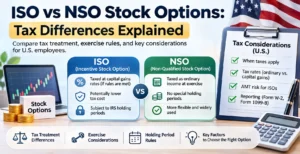
For a deeper comparison, read CalcZest’s ISO vs. NSO Stock Options: Tax Differences Explained.
You can also consult the IRS Stock Options Tax Topic 427.
Internal Revenue Service+2
6. How Does Exercising Private Company Stock Options Work?
Exercising stock options means purchasing company shares at the predetermined exercise price.
Employees generally exercise only options that have vested, unless the company permits early exercise.
The exercise price is usually lower than the company’s estimated current common stock value when the company has grown successfully.
How to Calculate the Stock Option Exercise Cost
The basic formula is:
Exercise Cost = Options Exercised * Exercise Price
Consider an employee with 3,000 vested options and an exercise price of $4 per share.
3,000 * $4 = $12,000
The employee needs $12,000 to exercise all 3,000 options, excluding applicable taxes and fees.
Calculate the Potential Option Spread
Suppose the current common stock fair market value is $12 per share.
Spread=FMV-ExercisePrice
$12 – $4 = $8
The total potential spread is:
3,000 * $8 = $24,000
Private Company Stock Option Example
Vested options
3,000
Exercise price
$4
Estimated share value
$12
Exercise cost
$12,000
Illustrative gross spread
$24,000
This is not guaranteed profit or available cash. Taxes, restrictions, dilution, and future company value can change the outcome.
Steps to Exercise Private Company Stock Options
- Check your equity compensation account for vested options.
- Review the exercise price and expiration date.
- Read the option agreement and stock option plan.
- Confirm the company’s current exercise procedures.
- Calculate the exercise cost and potential tax liability.
- Submit an exercise notice through the company’s approved platform.
- Pay the exercise price and applicable fees.
- Obtain confirmation of the share issuance and retain your records.
The company may also require additional documents, including shareholder agreements, investment representations, or transfer restriction acknowledgments.
An exercise is not complete simply because an employee clicks an exercise button. The company’s plan and applicable legal documents determine when the transaction becomes effective.
7. How Are Private Company Stock Options Taxed?
Tax treatment is one of the most important considerations when exercising private company stock options.
The IRS generally distinguishes between ISOs and NSOs.
NSO Tax Example
Suppose an employee has:
- 2,000 NSOs.
- Exercise price: $5.
- Fair market value at exercise: $20.
Exercise cost:
2,000 * $5 = $10,000
Stock value:
2,000 * $20 = $40,000
Taxable compensation spread:
$40,000 – $10,000 = $30,000
The employee generally recognizes $30,000 in ordinary compensation income when exercising the options.
For an employee, this amount is generally reported through payroll and Form W-2.
The applicable federal income tax, Social Security, Medicare, and state tax consequences depend on the employee’s circumstances and applicable rules.
ISO Tax Example
Suppose an employee exercises 2,000 ISOs with:
- Exercise price: $5.
- Fair market value: $20.
- Total exercise cost: $10,000.
- Total stock value: $40,000.
- Exercise spread: $30,000.
For regular federal income tax purposes, the employee generally does not recognize ordinary compensation income at ISO exercise.
However, the $30,000 spread may be an adjustment when calculating alternative minimum taxable income.
This can create an AMT liability even if the employee has not sold the shares.
The employee should use the applicable year’s IRS Form 6251 instructions to understand the calculation.
What Happens When You Sell the Shares?
After exercising, the employee owns shares rather than an unexercised option.
When those shares are eventually sold, the difference between the sale proceeds and the applicable tax basis may create a capital gain or loss.
For NSOs, the exercise spread generally becomes part of the basis because it was already recognized as compensation.
For ISOs, regular tax and AMT basis may differ, particularly when the exercise creates an AMT adjustment.
This is why employees should maintain separate records for their regular tax and AMT calculations.
8. What Is the Risk of Exercising Private Company Stock Options Without Liquidity?
One of the biggest risks associated with private company stock options is exercising without having a way to sell the shares.
Publicly traded companies have stock exchanges where investors can generally buy and sell shares during market hours.
Private companies usually do not have this continuous public trading environment.
As a result, employees may pay thousands of dollars to exercise options without receiving any immediate cash.
Example: Exercising Without a Liquidity Event
Suppose an employee exercises 5,000 options.
| Description | Amount |
| Exercise price | $3 |
| Shares exercised | 5,000 |
| Total exercise cost | $15,000 |
| Estimated fair market value | $10 |
| Estimated gross share value | $50,000 |
| Illustrative spread | $35,000 |
The employee pays $15,000 to acquire shares with an estimated value of $50,000.
However, the employee cannot necessarily sell those shares.
If the company does not have a liquidity event, the employee may have to wait several years before receiving cash.
For NSOs, the employee may also owe tax on the exercise spread even though the shares remain illiquid.
For ISOs, the employee may face AMT exposure.
What If the Company’s Valuation Falls?
Private-company valuations are not guaranteed to increase.
Suppose the company’s estimated common stock value falls from $10 to $2 after the employee exercises.
The employee originally paid $15,000 for 5,000 shares.
At the new estimated value, the shares are worth only $10,000.
The employee has an estimated decline of $5,000 before considering taxes, transaction restrictions, and other factors.
This is why exercising options based only on a company’s latest valuation can be risky.
Before exercising, employees should evaluate whether they can afford to lose the exercise cost and any associated taxes.
9. How Can Employees Sell Private Company Shares?
Employees generally cannot sell private-company shares whenever they want.
The company may restrict share transfers through its equity plan, shareholder agreements, articles of incorporation, or other legal documents.
However, several liquidity events may allow employees to sell their shares.
A. Initial Public Offering (IPO)
An IPO occurs when a private company begins offering shares to public investors through a registered public offering and listing process.
An IPO can create a public market for company shares.
However, employees should not assume they can sell immediately after the IPO.
They may be subject to:
- Lock-up agreements.
- Securities trading restrictions.
- Insider trading policies.
- Registration requirements.
- Company trading windows.
A lock-up period often prevents certain shareholders from selling shares for a specified period after an IPO.
The actual restrictions depend on the transaction documents and applicable securities laws.
B. Company Acquisition
An acquisition occurs when another company purchases or merges with the private business.
Depending on the transaction, employee shareholders may receive:
- Cash.
- Public-company shares.
- A combination of cash and stock.
- Replacement equity awards.
- Another form of transaction consideration.
The treatment depends on the acquisition agreement, capitalization structure, liquidation preferences, and individual equity rights.
An acquisition does not guarantee that every employee will receive the same amount per share.
C. Tender Offer
A tender offer allows eligible shareholders to sell some or all of their shares under specified terms.
Some private companies conduct employee tender offers to provide liquidity before an IPO or acquisition.
For example, a company may permit eligible employees to sell up to 20% of their vested shares at an approved price.
However, the company determines the eligibility criteria and transaction conditions.
D. Secondary Market Sale
A secondary sale involves an existing shareholder selling shares to another buyer rather than the company issuing new shares.
Private-company secondary transactions may require:
- Company approval.
- Right-of-first-refusal procedures.
- Transfer documentation.
- Securities law compliance.
- Buyer eligibility checks.
Not every private company permits employees to participate in secondary sales.
Important: A liquidity event is a potential opportunity to receive cash, not a guaranteed outcome of accepting stock options.
10. What Happens to Stock Options When You Leave a Private Company?
Leaving a private company can significantly affect your stock options.
The outcome generally depends on whether the options are vested or unvested and the post-termination exercise provisions in your agreement.
Unvested Options
Unvested options are generally forfeited when employment ends.
For example, suppose an employee receives 4,000 options and has vested 2,500 when resigning.
The remaining 1,500 unvested options will generally be cancelled.
Vested Options
Vested options may remain exercisable for a limited period after termination.
The period depends on the option agreement and applicable law.
For ISOs, the general federal tax rule requires exercise within three months after employment ends to preserve ISO treatment. A longer period generally applies for qualifying disability terminations.
Exercising outside the applicable ISO employment window may cause the option to lose ISO treatment, even if the agreement permits the employee to exercise it later as an NSO.
For NSOs, the post-termination exercise period is primarily determined by the plan and award agreement.
Some companies provide 90 days, while others allow longer periods.
Example: Leaving With Vested Options
An employee leaves a startup with:
- 2,000 vested options.
- Exercise price: $4.
- Post-termination exercise period: 90 days.
The employee generally must decide whether to exercise within that period.
If the deadline passes without exercise, the options may expire.
This can create a difficult decision because the employee may need to invest significant money in shares that cannot immediately be sold.
Always check the actual agreement rather than assuming every private company provides a 90-day exercise period.
11. What Is Early Exercise and How Does an 83(b) Election Work?
Some private companies allow employees to exercise options before they have fully vested.
This arrangement is called early exercise.
Early exercise allows an employee to purchase shares before satisfying the entire vesting schedule.
The purchased shares may remain subject to the company’s right to repurchase unvested shares if the employee leaves.
This arrangement can create a tax planning opportunity in certain circumstances.
What Is an 83(b) Election?
Section 83(b) of the Internal Revenue Code allows an eligible taxpayer who receives substantially nonvested property in connection with services to elect to include its value in income at the time of transfer rather than waiting for vesting.
The election generally must be filed within 30 days after the property transfer.
The election is not automatically available for every stock option grant.
For example, a typical unexercised NSO is not itself eligible for an 83(b) election merely because it has been granted.
However, if an employee early-exercises options and receives actual restricted shares subject to vesting or repurchase restrictions, an 83(b) election may be available.
Example of Early Exercise
Suppose an employee receives 10,000 options at $0.50 per share.
The employee early-exercises all 10,000 options while the fair market value is also $0.50.
The exercise cost is:
10,000 * $0.50 = $5,000
If the shares are subject to substantial vesting restrictions, the employee may consider an 83(b) election.
When the spread at transfer is zero, the amount included in income through the election may also be zero.
If the company’s value increases significantly over the next four years, the employee may have a different tax outcome than if they waited until vesting, depending on the applicable award and tax rules.
Important Risks of an 83(b) Election
An 83(b) election is not automatically beneficial.
If the employee leaves and forfeits the unvested shares, they generally cannot recover the tax paid solely because the shares were later forfeited.
The election also has strict timing requirements.
Review the official IRS Form 15620 and Section 83(b) instructions before considering this strategy.
IRS+2
12. What Is SEC Rule 701 and Why Does It Matter for Private Company Employees?
Private companies commonly rely on SEC Rule 701 when offering securities as compensation to employees and other eligible service providers.
Rule 701 provides an exemption from Securities Act registration for certain compensatory securities offerings by eligible non-reporting companies.
It helps qualifying private companies issue equity compensation without registering every offer and sale under the standard public offering registration process.
However, Rule 701 does not mean that employees can freely sell their shares.
Important Rule 701 Considerations
- The exemption is generally unavailable to companies that are subject to Exchange Act reporting requirements.
- Securities issued under Rule 701 are generally restricted securities.
- Resale may require registration or an available exemption.
- Companies exceeding $10 million in securities sold under Rule 701 during a 12-month period must provide specified additional disclosure to recipients within the applicable time requirements.
These disclosure requirements can include financial statements and other company information.
Employees should understand that receiving shares under Rule 701 does not automatically create a public trading market.
For more information, review the SEC’s official Rule 701 guidance.
Employee Benefit Plans – Rule 701+1
13. How Should You Evaluate a Private Company Stock Option Offer?
When evaluating a startup job offer, employees should look beyond the number of options offered.
A grant of 10,000 options may sound attractive, but the actual financial value depends on the company’s capitalization, exercise price, vesting terms, share class, and future liquidity.
Questions to Ask Before Accepting Stock Options
1. How many fully diluted shares does the company have?
This helps you understand your potential ownership percentage.
2. What is the exercise price?
The exercise price determines how much you must pay to purchase shares.
3. What is the latest 409A valuation?
This helps you understand the company’s estimated common stock fair market value for relevant compensation purposes.
4. Are the options ISOs or NSOs?
The tax consequences can differ significantly.
5. What is the vesting schedule?
Check the cliff, monthly or quarterly vesting, and performance requirements.
6. What is the post-termination exercise window?
Understand how much time you have to exercise after leaving.
7. Does the company permit early exercise?
This can affect your tax planning options.
8. Is there a realistic liquidity opportunity?
Ask about previous tender offers, secondary transactions, IPO plans, and acquisition possibilities without treating management projections as guarantees.
9. What are the transfer restrictions?
Understand whether you need company approval before selling shares.
10. What happens if the company raises additional capital?
New funding rounds can dilute existing shareholders.
How to Calculate Your Potential Ownership Percentage
A simplified ownership formula is:
OwnershipPercentage=YourOptionsFullyDilutedShares100
Suppose:
- Employee options: 10,000.
- Fully diluted company shares: 10,000,000.
10,000 / 10,000,000 * 100 = 0.1%
The employee’s potential ownership is 0.1% on the stated fully diluted basis, assuming all options are exercised and no other adjustments apply.
This percentage may decrease after future financing rounds or additional equity grants.
For more information about evaluating equity value, read How to Calculate the Value of Employee Shares.
14. Can Private Company Stock Options Qualify for the QSBS Tax Exclusion?
Another tax consideration worth understanding is Qualified Small Business Stock (QSBS) under Section 1202 of the Internal Revenue Code.
QSBS rules may allow eligible shareholders to exclude some or all of the gain from selling qualifying small-business stock, subject to statutory requirements and applicable limitations.
This can be particularly relevant to startup employees who exercise stock options and later sell their shares following an acquisition or IPO.
However, not every startup qualifies, and not every employee stock option automatically produces QSBS.
Important considerations include:
- Whether the company is a qualifying domestic C corporation.
- Whether the company satisfies the applicable gross-asset requirements.
- Whether the business conducts a qualifying active trade or business.
- Whether the shares were acquired at original issuance.
- Whether the applicable holding-period requirements are satisfied.
- Whether the shareholder meets other statutory conditions.
The timing of stock acquisition is particularly important.
For stock acquired through option exercise, the relevant holding period generally requires careful analysis of when the underlying shares were actually acquired.
Important: QSBS treatment is not guaranteed simply because you work for a startup. Employees should obtain advice from a tax professional familiar with Section 1202 before relying on a potential exclusion.
See the IRS guidance on Qualified Small Business Stock for relevant requirements.
Internal Revenue Service+1
Frequently Asked Questions About Private Company Stock Options
1. Can you sell private company stock options?
Generally, employees cannot freely sell their unexercised private-company stock options. Options are usually subject to transfer restrictions. Employees may eventually sell the underlying shares through an approved secondary transaction, tender offer, acquisition, or IPO, depending on the company’s policies and applicable securities laws.
2. Do private company stock options have real value?
They can have economic value if the company’s common stock value exceeds the exercise price. However, their estimated value is not guaranteed cash. Exercise costs, taxes, dilution, transfer restrictions, and liquidity limitations must be considered.
3. What happens to stock options if a startup fails?
If a startup becomes insolvent or shuts down, its stock options may become worthless. Even exercised shares may have little or no recovery value after creditors and other senior claims are addressed. Employees should not treat startup equity as guaranteed compensation.
4. Can you exercise stock options before they vest?
Sometimes. Companies that permit early exercise allow employees to purchase shares before all options have vested. The purchased shares may remain subject to repurchase restrictions. Early exercise can also create an opportunity for an 83(b) election when the actual shares qualify.
5. What is the typical vesting schedule for startup stock options?
A common startup arrangement is four-year vesting with a one-year cliff, followed by monthly vesting. However, companies can use different schedules depending on their compensation policies and individual agreements.
6. What happens to vested stock options when you resign?
Vested options generally remain exercisable for a limited post-termination period. The applicable deadline depends on the stock option agreement and plan. ISO tax qualification has a separate federal employment-related deadline, generally three months after termination.
7. Do you pay taxes when private company stock options are exercised?
It depends on the option type. Typical NSOs generally create ordinary compensation income equal to the exercise spread. ISOs generally do not create regular federal income tax at exercise, but the spread may trigger an AMT adjustment.
8. Can you exercise private company stock options without selling the shares?
Yes. Employees can exercise vested options and hold the resulting shares if the plan and company procedures permit it. However, this can create significant financial risk because the employee may pay exercise costs and taxes without receiving cash from a sale.
9. What happens to stock options when a company goes public?
An IPO may create a public market for the underlying shares. However, employees may face lock-up agreements, insider trading restrictions, and company trading windows. Unexercised options remain subject to their original award terms unless modified through the IPO transaction.
10. What is the difference between a 409A valuation and a funding valuation?
A 409A valuation estimates the fair market value of private-company common stock for relevant compensation purposes. A funding valuation often reflects the price investors pay for preferred shares. The two can differ because preferred shares may have additional rights and protections.
11. Can private company stock options expire?
Yes. Stock options generally have an expiration date established by the option agreement. Many plans use a maximum 10-year term, although shorter periods may apply. Options may also expire earlier after employment termination if the applicable exercise deadline passes.
12. Are private company stock options better than RSUs?
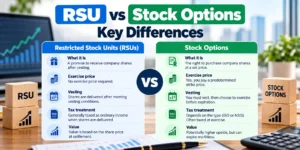
Neither is universally better. Stock options provide the right to purchase shares at an exercise price, while RSUs generally represent a promise to deliver shares after applicable conditions are satisfied. Options may have greater upside potential but require an exercise investment and carry additional liquidity and tax risks.
13. What is a double-trigger stock option?
The term double-trigger commonly describes equity arrangements in which two qualifying events are required for a particular benefit, such as vesting acceleration: a change in company control and a qualifying employment termination. The precise conditions depend on the equity agreement. It should not be confused with ordinary time-based option vesting.
14. Do private company stock options qualify for long-term capital gains?
Potentially. The treatment depends on whether the options are ISOs or NSOs, the exercise date, the sale date, and applicable holding-period requirements. ISO shares have special qualifying-disposition rules, while NSO shares generally receive capital gains treatment on appreciation after exercise.
15. Is an ESOP the same as private company stock options?
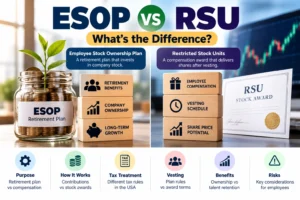
No. In the United States, an Employee Stock Ownership Plan (ESOP) is generally a qualified retirement plan that invests primarily in employer stock. Employee stock options are contractual rights to purchase shares at a predetermined price. They are different equity and employee-benefit arrangements.
Conclusion: Are Private Company Stock Options Worth It?
Private company stock options can be a valuable part of an employee compensation package, especially when a startup experiences significant growth.
They give employees the opportunity to purchase company shares at a predetermined price and potentially benefit from future increases in company value.
However, receiving stock options does not guarantee financial returns.
Employees must understand their vesting schedule, exercise price, option expiration date, ISO or NSO classification, 409A valuation, tax obligations, and restrictions on selling private-company shares.
The biggest mistake is treating the estimated value of startup equity as guaranteed money.
A company may have an impressive valuation, but employees may still be unable to sell their shares for several years. Exercising options can also require substantial cash and may create tax liabilities before any liquidity event.
Before accepting or exercising an award, review the actual equity documents and evaluate the financial risks.
Ultimately, private company stock options are an opportunity to participate in potential company growth, not a guaranteed financial return. Their real value depends on the company’s future performance, your exercise decisions, applicable tax rules, and your ability to convert shares into cash.
Disclaimer: This article is for educational purposes and explains general US federal equity compensation and tax principles. It is not legal, tax, investment, or financial advice. Individual outcomes depend on the equity incentive plan, option agreement, company structure, applicable federal and state laws, and personal tax circumstances. Consult a qualified tax professional or employment attorney before making significant equity compensation decisions.