
Introduction
Understanding markup percentage is essential for business owners, retailers, freelancers, wholesalers, and anyone who needs to set prices for products or services. A suitable markup helps a business cover its costs, generate profit, and maintain competitive prices.
Whether you sell clothing, electronics, handmade products, or professional services, calculating markup percentage helps you determine how much to add to your cost before setting a selling price.
For example, if a product costs $50 and you sell it for $75, your markup is $25, or 50% of the original cost. However, the markup percentage is not the same as profit margin. Understanding this difference is important when evaluating profitability and making pricing decisions.
In this guide, you will learn how to calculate markup percentage, use the formula in real-world examples, distinguish markup from profit margin, and apply practical pricing strategies for businesses in the United States.
What Is Markup Percentage?
Markup percentage is the percentage added to the cost of a product or service to determine its selling price.
It measures how much higher the selling price is than the original cost, expressed as a percentage of that cost.
For example, suppose a retailer purchases a pair of shoes for $40 and sells them for $60. The difference is $20.
- Original cost: $40
- Selling price: $60
- Markup amount: $20
- Markup percentage: 50%
This means the retailer added an amount equal to 50% of the product’s cost.
Businesses use markup to establish prices, estimate gross profit, compare product profitability, and plan for operating expenses. However, a markup does not automatically represent net profit because a business may still need to pay rent, wages, advertising expenses, transaction fees, and other operating costs.
For additional business-planning guidance, consult the U.S. Small Business Administration (SBA), which provides resources on estimating expenses and evaluating business viability.
Small Business Administration
+1
How to Calculate Markup Percentage
The markup percentage formula is straightforward. You need to know the product’s cost and its selling price.
Markup Percentage Formula
Markup Percentage = Selling Price – Cost / Cost * 100
Where:
- Selling price: The amount charged to the customer, excluding separately collected sales tax.
- Cost: The relevant cost used for pricing the product or service.
- Markup amount: The difference between selling price and cost.
The calculation has three steps:
- Subtract the cost from the selling price.
- Divide the difference by the original cost.
- Multiply the result by 100 to convert it into a percentage.
Example: Calculating Markup Percentage
Suppose you purchase a product for $80 and sell it for $120.
Step 1: Calculate the markup amount.
$120 – $80 = $40
Step 2: Divide the markup amount by the cost.
$40 / $80 = 0.50
Step 3: Convert the result into a percentage.
0.50 * 100 = 50%
Answer: The markup percentage is 50%.
This means the selling price is 50% higher than the product’s original cost.
How to Calculate Selling Price Using Markup Percentage
Sometimes, you know the product’s cost and the markup percentage you want to apply, but you have not decided on a selling price.
In this situation, use the following formula:
Selling Price = Cost * ( 1 + Markup Percentage / 100 )
Example: Applying a 40% Markup
Suppose your business purchases a product for $100 and wants to apply a 40% markup.
Step 1: Convert the percentage into a decimal.
40 / 100 = 0.40
Step 2: Multiply the cost by one plus the markup rate.
$100 * ( 1 + 0.40 ) = $140
Final selling price: $140.
The markup amount is $40, which equals 40% of the original $100 cost.
Here are some additional examples:
| Product cost | Markup percentage | Markup amount | Selling price |
| $20 | 25% | $5 | $25 |
| $50 | 30% | $15 | $65 |
| $80 | 50% | $40 | $120 |
| $100 | 60% | $60 | $160 |
| $200 | 75% | $150 | $350 |
These examples demonstrate how different markup rates affect the final selling price.
How to Calculate Markup Percentage in Excel
Microsoft Excel can calculate markup percentage automatically, making it easier to manage pricing for multiple products.
Suppose your spreadsheet contains the following information:
| Cell | Information | Value |
| A2 | Product cost | $50 |
| B2 | Selling price | $75 |
| C2 | Markup percentage | Formula |
To calculate markup percentage, enter this formula in cell C2:
=((B2-A2)/A2)*100
The result will be 50, meaning the markup percentage is 50%.
Alternatively, use:
=(B2-A2)/A2
Then format the cell as a percentage using Excel’s Percentage format. The result will display as 50%.
Calculate Selling Price in Excel
If cell A2 contains the cost and B2 contains the desired markup percentage, enter:
=A2*(1+B2)
Format B2 as a percentage. For example, if A2 is $100 and B2 is 40%, the formula returns $140.
This approach is useful for retail stores, wholesalers, e-commerce businesses, and product distributors managing large inventories.
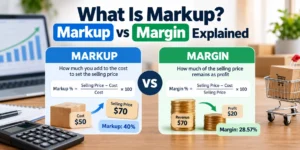
What Is the Difference Between Markup and Profit Margin?
Markup and profit margin are closely related, but they measure profitability differently. Confusing them can cause a business to set prices incorrectly.
Markup percentage is calculated using cost, while profit margin is calculated using selling price.
The markup formula is:
Markup% = Selling Price – Cost / Cost * 100
The gross profit margin formula is:
Gross Margin % = Selling Price – Cost / Selling Price * 100
Markup vs. Profit Margin Example
Suppose a product costs $60 and sells for $90.
- Cost: $60
- Selling price: $90
- Gross profit before other expenses: $30
Markup percentage:
90 – 60 / 60 * 100 = 50%
Gross profit margin:
90 – 60 / 90 * 100 = 33.33%
The markup is 50%, but the gross profit margin is approximately 33.33%.
Quick comparison
Markup percentage
50%
Profit divided by cost
Gross profit margin
33.33%
Profit divided by selling price
For a more detailed explanation of how these calculations relate, see AccountingCoach’s guide to markup and gross margin.
AccountingCoach.com
+1
How to Convert Profit Margin to Markup
If you know your target gross profit margin and want to calculate the equivalent markup, use this formula:
Markup % = Gross Margin % / 100 – Gross Margin % * 100
For example, if you want a 30% gross profit margin:
30 / 100 – 30 * 100 = 42.86%
You need a markup of approximately 42.86% on cost to achieve a 30% gross margin, assuming the cost and selling price are measured consistently.
Why Is Markup Percentage Important for Businesses?
Markup percentage is an important pricing tool because it helps businesses establish prices systematically rather than relying on guesswork.
1. Helps Cover Business Costs
Businesses have costs beyond the purchase price of a product. These may include shipping, packaging, storage, labor, rent, payment processing fees, and advertising.
A carefully planned markup helps generate enough gross profit to contribute toward these expenses.
For example, a retailer may purchase a product for $25 and sell it for $35. The $10 difference is not necessarily net profit because the retailer must still account for other expenses.
2. Supports Consistent Pricing
Businesses that sell many products can use a standard markup policy to simplify pricing.
For instance, a store might use different markup rates for clothing, accessories, and seasonal products. These rates should reflect each category’s costs, demand, competition, and operating requirements.
3. Helps Evaluate Product Performance
Calculating markup percentage helps business owners compare products and identify pricing opportunities.
However, a higher markup percentage does not always mean a product generates more total profit. A lower-priced product with a higher sales volume may contribute more total gross profit than an expensive product that rarely sells.
4. Supports Business Planning
Markup calculations can be combined with cost estimates, expected sales volumes, and fixed expenses to evaluate whether a pricing strategy is sustainable.
The SBA’s break-even analysis guide explains how businesses can estimate the sales needed to cover fixed and variable costs.
U.S. Small Business Administration
+1
What Costs Should You Include When Calculating Markup?
The accuracy of your markup percentage depends on how accurately you calculate your costs.
For a retailer, the initial cost might be the amount paid to purchase a product. For a manufacturer, the production cost may include materials, direct labor, and allocated manufacturing overhead.
Depending on your business model, relevant costs may include:
- Purchase or production costs: The amount paid to acquire or manufacture the product.
- Shipping and freight: Costs associated with transporting inventory.
- Packaging: Boxes, labels, protective materials, and other packaging supplies.
- Direct labor: Labor directly associated with producing or preparing the product.
- Import expenses: Applicable duties, brokerage fees, and other costs associated with importing goods.
- Payment processing: Fees charged by payment providers, where relevant to your pricing model.
- Operating overhead: Rent, utilities, insurance, and administrative expenses that must be covered by overall sales.
Not every expense should be added directly to each product’s cost in the same way. Businesses should use a consistent accounting method and distinguish direct product costs from operating expenses.
For U.S. tax and accounting context, the IRS Publication 334: Tax Guide for Small Business explains cost of goods sold, gross profit, and the treatment of business purchases.
Internal Revenue Service
+1
Important: If you use only the supplier’s purchase price to calculate markup, your result may not reflect the markup needed to cover all your business expenses. Consider the full cost structure before finalizing your prices.
How to Choose the Right Markup Percentage
There is no single markup percentage that works for every U.S. business. The appropriate rate depends on the product, industry, competition, customer expectations, and total cost structure.
Consider the following factors when setting your markup.
Industry and Product Type
Different products have different cost structures, sales volumes, and customer expectations. A markup suitable for one category may not work for another.
For example, a business selling specialized accessories may use a different markup from a wholesaler selling large quantities of commodity products.
Competition and Customer Demand
Research competing products and evaluate what customers are willing to pay. A price that covers your costs may still be too high for the market.
However, competing only on price can also reduce profitability. The SCORE resource on pricing products and services recommends considering costs, competition, and customer willingness to pay when establishing prices.
SCORE
+1
Operating Expenses
A markup should help your business contribute toward expenses that are not included in the product’s direct cost.
For example, if you purchase a product for $40 and sell it for $60, the $20 difference is gross profit before other applicable expenses. It is not necessarily the amount you take home.
Sales Volume and Inventory Risk
Products that sell slowly may create storage costs or require discounts. Perishable, seasonal, or frequently changing products may also involve greater inventory risk.
Include these considerations when reviewing whether your markup is sufficient.
Markup Percentage and U.S. Sales Tax Considerations
When pricing products in the United States, businesses should distinguish their selling price from sales tax collected from customers.
Sales tax rules vary by state and locality, and taxability depends on the product, service, transaction, and applicable law. Businesses may also have registration and collection obligations depending on where they operate and their economic or physical presence.
For example, if a product’s selling price is $100 and an applicable 8% sales tax is added at checkout, the customer pays $108. The $8 tax is generally collected for the relevant tax authority; it is not an additional $8 of markup or product profit.
This example is illustrative only. The applicable tax rate and whether tax must be collected depend on the transaction.
The IRS explains certain federal reporting treatments for sales taxes collected from buyers in its Schedule C instructions. State and local sales tax requirements should be verified with the relevant state tax agency.
Internal Revenue Service
+1
There is no universal federal markup percentage that every U.S. retailer must apply to ordinary products. Businesses generally determine their prices based on their costs and commercial strategy, subject to applicable industry-specific requirements and other laws.
This article provides general educational information, not individualized tax, legal, or accounting advice.
Common Mistakes to Avoid When Calculating Markup Percentage
Even a simple formula can produce misleading results when the inputs are incorrect.
Using selling price instead of cost as the denominator. This calculates gross profit margin rather than markup percentage.
Ignoring additional costs. A markup based only on the purchase price may be insufficient to cover delivery, packaging, labor, and overhead.
Treating gross profit as net profit. Gross profit does not automatically account for every operating expense, tax, or financing cost.
Applying the same markup to every product. Different products may have different costs, sales volumes, competitive pressures, and inventory risks.
Forgetting discounts and returns. Promotions, refunds, and allowances can reduce actual revenue. Review realized selling prices rather than relying solely on list prices.
Including sales tax incorrectly. Separately collected sales tax should not normally be treated as product revenue when calculating the product’s markup.
To improve accuracy, maintain reliable purchase records, review pricing periodically, and use consistent cost assumptions. The IRS recordkeeping guide provides information about documents businesses can use to support their records.
Internal Revenue Service
+1
Frequently Asked Questions
1. What is the formula for markup percentage?
The formula is:
Selling Price – Cost / Cost * 100
Subtract the cost from the selling price, divide the result by the cost, and multiply by 100.
2. How do you calculate a 25% markup?
Multiply the product’s cost by 1.25.
For a product costing $80:
$80 * 1.25 = $100
The selling price is $100, and the markup amount is $20.
3. Is a 50% markup the same as a 50% profit margin?
No. A 50% markup means the markup amount is 50% of the cost. A 50% gross profit margin means gross profit equals 50% of the selling price.
For a 50% markup, the corresponding gross margin is 33.33%, assuming no additional costs are included in the calculation.
4. Can markup percentage be greater than 100%?
Yes. If a product costs $20 and sells for $50, the markup amount is $30.
50 – 20 / 20 * 100 = 150%
The markup is 150%, while the gross profit margin is 60%.
5. Can markup percentage be negative?
Yes. If the selling price is below the cost used in the calculation, the markup percentage is negative.
For example, if a product costs $100 and sells for $80, the markup percentage is −20%. This indicates that the selling price is 20% below that cost, before considering other expenses.
6. What is a good markup percentage for a small business?
There is no universal ideal markup. A suitable rate depends on direct costs, operating expenses, competition, demand, and the business’s financial goals. Calculate your costs first, compare market prices, and evaluate whether the resulting selling price is commercially viable.
Conclusion
Learning how to calculate markup percentage helps you set prices, understand gross profit, and make more informed business decisions.
The main formula is simple:
Markup % = Selling Price – Cost / Cost * 100
Remember that markup and gross profit margin are different calculations. Also, a markup does not automatically represent net profit because businesses must account for other relevant expenses.
For more reliable pricing, use accurate cost information, consider market conditions, review your margins regularly, and follow applicable U.S. tax and business requirements.
Whether you are running a retail store, managing an online business, or pricing manufactured products, a consistent markup calculation can help you build a more informed and sustainable pricing strategy.