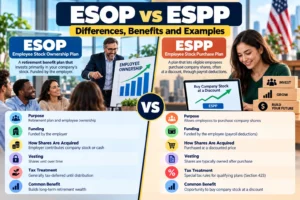
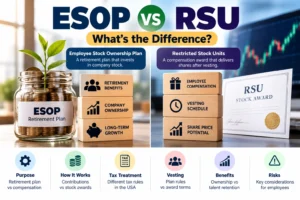
ESOP stands for Employee Stock Ownership Plan. In the United States, it is a qualified, employer-sponsored retirement plan designed primarily to invest in the sponsoring company’s stock.
The plan operates through a trust that holds company shares for the benefit of eligible employees. Employees generally receive allocations to their individual ESOP accounts without purchasing those shares directly with their own wages.
An ESOP is different from an employee stock option plan in which employees may receive the right to purchase shares at a specified price. The US retirement-plan meaning of ESOP is the focus of this article.
How Does an ESOP Work?
An ESOP follows a structured process involving the employer, an ESOP trust, company shares, employee accounts, and eventual benefit distributions.
1. The company establishes an ESOP
The employer adopts plan documents and establishes a trust to hold company stock for eligible participants.
2. The trust acquires company shares
The trust may receive company contributions or purchase shares from existing owners. Some ESOPs borrow money to finance a share purchase.
3. Shares are allocated to employee accounts
The plan distributes allocations according to its terms, which may consider compensation, service, or other permitted allocation factors.
4. Account values change over time
The value of an employee’s account can rise or fall with the value of company stock and other plan assets, along with contributions, allocations, distributions, and expenses.
5. Employees receive benefits under the plan
Eligible participants generally receive their vested benefits when distributions become due under the plan’s terms and applicable federal law.
A common use of an ESOP is to help a privately held company transition ownership from its founder or existing shareholders to its employees through a trust. However, not every ESOP involves a complete ownership transfer. Some plans own only part of a company.
For a visual overview, see the National Center for Employee Ownership’s ESOP explanation.
Types of ESOPs: Leveraged vs. Non-Leveraged
ESOPs can be structured in different ways depending on how the plan acquires company shares.
Leveraged ESOP
A leveraged ESOP uses borrowed funds to purchase company stock. The loan may come from an outside lender, the selling shareholder, or another permitted source.
In a typical arrangement:
- The ESOP trust borrows money to purchase shares.
- The trust acquires shares for the benefit of participants.
- Company contributions help fund loan repayments.
- Shares are released from the loan-related suspense account and allocated to employee accounts as required under the plan and applicable rules.
A leveraged ESOP can help an owner sell a substantial portion of a business without requiring employees to pay for shares directly. However, the transaction creates financing obligations and requires careful valuation, legal structuring, and cash-flow planning.
Non-Leveraged ESOP
A non-leveraged ESOP does not use a loan to acquire shares. Instead, the company may contribute shares directly to the trust or contribute cash that the trust uses to purchase shares.
This arrangement can allow employee ownership to build gradually over time rather than through a single debt-financed transaction.
Both structures must comply with applicable retirement-plan requirements, including rules governing contributions, valuations, fiduciary responsibilities, and distributions.
How Are ESOP Shares Allocated to Employees?
The employer’s ESOP plan documents determine eligibility and the allocation formula, subject to applicable law.
For example, an allocation formula may consider employee compensation, years of service, or a combination of permitted factors. A company’s plan may also specify how shares are allocated as loans are repaid in a leveraged ESOP.
Consider a simplified example.
Suppose a company allocates a total of $100,000 in ESOP benefits among eligible employees for a plan year. If an employee’s compensation represents 5% of the compensation used in the plan’s allocation formula, that employee might receive a $5,000 allocation under a compensation-proportional formula.
This is an illustrative example, not a universal ESOP formula. Actual allocations depend on plan terms, the stock valuation, the available contribution or shares, and applicable legal requirements.
Employees should review their plan’s Summary Plan Description (SPD) to understand eligibility, allocations, vesting, and benefit distribution rules.
What Is ESOP Vesting?
Vesting determines how much of an employee’s ESOP benefit the employee has a nonforfeitable right to keep under the plan.
An employee may see shares or benefits allocated to an ESOP account before becoming fully vested. If the employee leaves the company before full vesting, the unvested portion may be forfeited according to the plan’s terms and applicable law.
For many ESOPs, federal law generally permits these two vesting schedules:
- Three-year cliff vesting: The employee becomes fully vested after completing three years of service, with no vesting before that point.
- Six-year graded vesting: The employee becomes 20% vested after two years of service, with vesting increasing by 20 percentage points each year until reaching 100% after six years.
A plan may provide faster vesting. Special rules can apply depending on the plan, the participant, and the circumstances.
Example of ESOP Vesting
Suppose an employee has an ESOP account worth $40,000 and is 60% vested.
The vested portion is:
$40,000 * 60% = $24,000
The employee’s vested benefit is $24,000 based on this simplified example. The actual amount payable and timing of payment depend on the plan’s distribution provisions and applicable law.
How Much Is an ESOP Worth?
The value of an ESOP account depends on the number of shares or other assets allocated to the account and their applicable value.
For a privately held company, shares generally do not have a readily available stock-market price. The company’s stock value is determined through a valuation process that must comply with applicable legal requirements.
For example, if an employee has 200 allocated shares and the applicable value is $150 per share, the illustrative account value attributable to those shares is:
200 * $150 = $30,000
This does not necessarily mean the employee can immediately withdraw $30,000. Vesting, plan expenses, distribution timing, payment terms, and applicable taxes may affect the benefit received.
What Can Increase or Decrease ESOP Value?
Several factors may affect an ESOP account’s value:
- Company revenue and profitability
- Business growth and future earnings expectations
- Company debt and financial obligations
- Changes in the value of company stock
- New allocations, distributions, and plan expenses
Because ESOP participants may depend on the same company for both employment income and retirement benefits, changes in the company’s performance can affect both their job security and retirement savings.
ESOP Tax Benefits and US Tax Rules
ESOPs can offer tax advantages to companies and eligible participants, but the specific treatment depends on the company’s structure, transaction type, and applicable Internal Revenue Code provisions.
Tax Treatment for Employees
ESOP contributions and allocations are generally not treated as current taxable income to the employee when credited to the account under a qualified plan. Taxes generally become relevant when benefits are distributed, subject to applicable rules and exceptions.
Depending on the distribution and the participant’s circumstances, distributions may be taxable as ordinary income. Eligible distributions may qualify for rollover treatment, allowing tax deferral if the applicable requirements are met.
Early distributions can trigger additional taxes in certain circumstances. Exceptions and special rules may apply.
Employees should not assume that an ESOP distribution is tax-free simply because the benefit was earned through employment.
Tax Advantages for Employers
Employers may receive deductions for qualifying contributions to an ESOP, subject to applicable federal tax limits and requirements. Leveraged ESOPs can also have particular tax and financing considerations.
Certain transactions involving stock in a closely held C corporation may qualify for special treatment under Internal Revenue Code Section 1042 when the statutory requirements are satisfied. This is a specific provision for qualifying selling shareholders, not a tax benefit automatically available to every ESOP transaction.
S corporation ESOPs also have distinct tax rules. For example, special limitations apply to deductions for contributions made by an ESOP-owned S corporation.
For authoritative guidance, consult the IRS Employee Stock Ownership Plans resource. Companies considering an ESOP should work with qualified tax, legal, valuation, and retirement-plan professionals before implementing a transaction.
ESOP vs. 401(k): What Is the Difference?
An ESOP and a 401(k) are both employer-sponsored retirement plans, but they serve different purposes and generally have different investment structures.
| Feature | ESOP | 401(k) |
| Primary purpose | Retirement benefits invested primarily in employer stock | Retirement savings with investment options under the plan |
| Main asset | Stock of the sponsoring company | Usually a range of investment options |
| Employee contributions | Generally funded by employer contributions | Employees can usually contribute from their pay |
| Investment diversification | Often concentrated in employer stock | Participants may choose among available investments |
| Benefit value | Closely linked to company stock value | Depends on contributions, investments, fees, and returns |
| Typical access | Subject to ESOP distribution rules | Subject to 401(k) withdrawal and distribution rules |
An ESOP is not simply a 401(k) account that allows employees to purchase any stock they want. It is a distinct qualified retirement plan designed primarily to hold employer securities.
A company may sponsor both an ESOP and a 401(k), potentially allowing employees to receive employee ownership benefits while also building a more diversified retirement portfolio.
Advantages of an ESOP
An ESOP can provide benefits to employees, business owners, and companies when structured and managed appropriately.
1. Employees Can Build Retirement Wealth
Eligible employees can accumulate retirement benefits through employer-funded allocations without necessarily purchasing shares using their own wages.
If the company performs well and its stock value increases, the value of the employee’s ESOP account may also rise.
2. It Can Support Business Succession
For owners of privately held businesses, an ESOP can provide a structured way to sell some or all of their ownership interest.
This can be useful for owners who want to transition ownership while maintaining business continuity.
3. It Can Encourage Employee Engagement
Employee ownership can create a stronger connection between employees and the company’s long-term performance. However, the effect depends on company culture, employee understanding, leadership, and how the plan is implemented.
4. It May Offer Tax Advantages
Qualifying contributions and certain transactions may receive favorable tax treatment under federal law. The availability and value of those benefits depend on the company’s structure and the specific transaction.
Disadvantages and Risks of an ESOP
Despite their potential advantages, ESOPs are not risk-free retirement plans.
1. Concentration Risk
An employee may depend on the same company for a paycheck, benefits, and retirement savings. If the company struggles financially, both employment and ESOP value may be affected.
This is one reason diversification matters when planning for retirement.
2. Business Debt
A leveraged ESOP can introduce substantial repayment obligations. If the company does not generate enough cash flow, debt service may constrain investment, growth, or other business needs.
3. Limited Liquidity
Employees generally cannot sell privately held ESOP shares whenever they choose. Benefits are distributed according to the plan’s terms and applicable law.
This differs from holding publicly traded shares in a standard brokerage account.
4. Complex Administration
ESOPs involve legal documents, annual valuations, plan administration, reporting, fiduciary oversight, and potentially complex financing arrangements.
The costs and responsibilities can be substantial, especially for smaller companies.
5. Company Performance Is Not Guaranteed
An ESOP account’s value can decline if the company’s financial performance or valuation deteriorates. Employee ownership does not guarantee investment gains or a specific retirement benefit.
ESOP Rules and Employee Protections in the United States
US ESOPs are subject to federal retirement-plan and tax rules. The Internal Revenue Service oversees tax qualification, while the US Department of Labor administers relevant requirements under the Employee Retirement Income Security Act of 1974 (ERISA).
Plan fiduciaries must act prudently and in the interests of plan participants and beneficiaries. This includes following the plan’s terms, managing conflicts of interest, and complying with applicable requirements concerning plan assets and transactions.
The Department of Labor also provides information about employee rights, plan documents, and fiduciary responsibilities. See its ESOP participant resources.
Employees should review their plan documents to understand their specific rights, including eligibility, vesting, diversification options, and distributions.
This article provides general educational information, not individualized investment, legal, or tax advice.
Frequently Asked Questions About ESOPs
1. What does ESOP stand for?
ESOP stands for Employee Stock Ownership Plan. In the United States, it is a qualified retirement plan designed primarily to invest in the sponsoring employer’s stock for the benefit of participating employees.
2. Do employees have to pay for ESOP shares?
Generally, employees do not purchase ESOP shares directly with their own wages. The company typically funds the plan through contributions or other permitted arrangements. The specific structure depends on the ESOP.
3. Can employees sell their ESOP shares?
Employees generally cannot freely sell ESOP shares whenever they want. Shares are held through the plan’s trust, and benefits are distributed under the plan’s terms and applicable law. Special rules can apply to privately held company stock.
4. What happens to an ESOP when an employee leaves a company?
The employee’s vested benefit generally remains subject to the plan’s distribution rules. Payment timing and form depend on the plan, the reason employment ended, and applicable federal requirements.
5. Is an ESOP better than a 401(k)?
Neither is automatically better. An ESOP can provide employer-stock ownership benefits, while a 401(k) typically offers a range of investment options. An ESOP can involve greater concentration risk, so employees should consider their overall retirement savings and diversification.
6. Are ESOP distributions taxable?
ESOP distributions are generally subject to applicable federal income tax rules. Eligible distributions may qualify for a rollover, which can defer taxation if the requirements are met. Tax treatment depends on the distribution type and the participant’s circumstances.
7. Can a small business establish an ESOP?
Yes. A small or privately held business may establish an ESOP if it meets applicable requirements and can support the plan’s financial, legal, and administrative responsibilities. Professional advice is important because ESOP transactions can be complex.
8. What happens if the company loses value?
The value of an ESOP account invested in company stock may decline if the company’s value falls. Employee ownership does not guarantee a minimum return or a specific retirement balance.
9. Is an ESOP the same as stock options?
No. An ESOP is a qualified retirement plan that holds employer stock for participants. Stock options generally provide the right to purchase shares at a specified price under an equity compensation arrangement. The terms and tax treatment differ.
10. Where can employees find their ESOP balance?
Employees can typically request account information from their plan administrator or recordkeeper. They should also review their Summary Plan Description and annual benefit statements to understand their account value, vesting percentage, and distribution rights.
Conclusion
An Employee Stock Ownership Plan (ESOP) is a US retirement plan that allows eligible employees to build retirement benefits linked primarily to their employer’s stock.
The company establishes a trust, funds the plan or facilitates the acquisition of company shares, and allocates benefits to employee accounts under the plan’s rules. Employees generally receive their vested benefits when distributions become due.
ESOPs can support retirement savings, employee ownership, and business succession. However, they also involve investment concentration, valuation, liquidity, and administrative risks.
Before making decisions about an ESOP, employees should understand their vesting schedule, account valuation, distribution rules, and tax implications. Employers considering an ESOP should obtain qualified legal, tax, financial, and valuation advice.
References
Used these authoritative resources in this article.
| Resource | Suggested anchor text | Purpose |
| Internal Revenue Service | IRS rules for Employee Stock Ownership Plans | Federal tax qualification and ESOP requirements |
| U.S. Department of Labor | ESOP participant rights and resources | Employee protections and plan documents |
| Department of Labor Fiduciary Guidance | ESOP fiduciary responsibilities | Fiduciary duties under ERISA |
| National Center for Employee Ownership | How an ESOP works | Educational explanation of ESOP structures |