Introduction
Understanding how much federal income tax you owe on your salary can help you manage your monthly budget, estimate your take-home pay, and avoid unexpected tax bills. However, calculating federal income tax is not as simple as multiplying your annual salary by one tax rate.
The United States uses a progressive federal income tax system. This means different portions of your taxable income are taxed at different rates. Your filing status, deductions, eligible adjustments, and other sources of income can also affect your final tax liability.
For example, if you earn $75,000 annually, you do not necessarily pay the same tax rate on every dollar you earn. Instead, your income falls into different federal tax brackets, and each portion is taxed according to the applicable rate.
In this guide, you will learn how to calculate federal income tax step by step, how to determine your taxable income, how federal tax brackets work, and how to estimate the tax on different salary amounts. You will also understand the difference between federal income tax and paycheck withholding, including why your take-home pay may differ from your actual tax liability.
The examples focus on the 2026 U.S. tax year. Actual tax results depend on individual circumstances and applicable IRS rules.
1. Understand How Federal Income Tax Works in the United States
The federal government collects income tax from individuals who earn taxable income. The Internal Revenue Service (IRS) administers federal income tax rules and processes individual tax returns.
The United States follows a progressive tax system. Under this system, the government divides taxable income into different ranges, called tax brackets. Each range has its own tax rate.
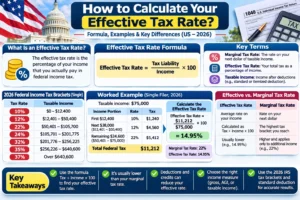
For the 2026 tax year, the federal income tax rates are:
- 10%
- 12%
- 22%
- 24%
- 32%
- 35%
- 37%
Your tax bracket depends on your taxable income and filing status, not simply your annual gross salary.
For example, two employees earning $80,000 may have different federal income tax liabilities if one files as single and the other files as married filing jointly.
The IRS also adjusts tax brackets annually to account for inflation. Therefore, always use the tax brackets for the correct tax year rather than relying on an older tax table.
Internal Revenue Service+1
2. Know the Difference Between Gross Salary, Adjusted Gross Income, and Taxable Income
Before calculating federal income tax, you need to understand three important income terms.
Gross Salary
Gross salary is the total amount your employer pays you before deductions and taxes.
For example, if your annual salary is $80,000, your gross annual salary is $80,000.
Your gross compensation may also include:
- Regular wages and salaries
- Bonuses and commissions
- Taxable allowances
- Certain employee benefits
- Other taxable compensation
However, some employer benefits and payroll contributions may receive special tax treatment.
Adjusted Gross Income (AGI)
Adjusted gross income is generally your total taxable income after subtracting eligible adjustments allowed by the IRS.
Depending on your circumstances, adjustments may include:
- Deductible traditional IRA contributions
- Eligible student loan interest
- Certain self-employed business expenses
- Deductible contributions to qualifying retirement arrangements
For example, assume you earn $80,000 annually and qualify for $2,000 in adjustments.
Your AGI would be:
$80,000 − $2,000 = $78,000
Taxable Income
Taxable income is the amount on which the federal income tax calculation is based after applying eligible deductions.
Most employees who do not itemize deductions use the standard deduction.
The basic formula is:
Taxable Income = Adjusted Gross Income − Standard Deduction
For the 2026 tax year, the standard deductions are:
| Filing status | 2026 standard deduction |
| Single | $16,100 |
| Married filing jointly | $32,200 |
| Married filing separately | $16,100 |
| Head of household | $24,150 |
These amounts apply to tax returns covering income earned during 2026, generally filed in 2027.
Internal Revenue Service+1
Example:
Suppose you are a single employee earning $80,000 annually and have no additional income adjustments.
- Gross salary: $80,000
- Adjustments: $0
- Adjusted gross income: $80,000
- Standard deduction: $16,100
- Taxable income: $63,900
You calculate federal income tax on $63,900, not the entire $80,000 salary.
3. Understand the 2026 Federal Income Tax Brackets
Federal tax brackets determine how much tax you pay on different portions of your taxable income.
The following table shows the 2026 federal income tax brackets for common filing statuses.
2026 Federal Income Tax Brackets
| Tax rate | Single | Married filing jointly |
| 10% | 0–12,400 | 0–24,800 |
| 12% | 12,401–50,400 | 24,801–100,800 |
| 22% | 50,401–105,700 | 100,801–211,400 |
| 24% | 105,701–201,775 | 211,401–403,550 |
| 32% | 201,776–256,225 | 403,551–512,450 |
| 35% | 256,226–640,600 | 512,451–768,700 |
| 37% | Over $640,600 | Over $768,700 |
The table uses taxable income rather than gross salary.
Internal Revenue Service+1
What Is a Marginal Tax Rate?
Your marginal tax rate is the rate applied to your next dollar of taxable income.
For example, if you are a single taxpayer with $70,000 in taxable income, your marginal tax rate is 22%.
However, this does not mean the IRS taxes all $70,000 at 22%.
The first $12,400 is taxed at 10%, the next $38,000 at 12%, and the remaining $19,600 at 22%.
This distinction is important because moving into a higher tax bracket does not mean all your income suddenly becomes subject to the higher rate.
4. How to Calculate Federal Income Tax on Your Salary Step by Step
You can calculate your estimated federal income tax by following these five steps.
Step 1: Determine Your Annual Gross Salary
Start with your annual salary before taxes and payroll deductions.
If you receive a monthly salary of $6,000:
$6,000 × 12 = $72,000
Your annual gross salary is $72,000.
If you receive hourly wages, multiply your hourly rate by the expected number of working hours and pay periods. Include expected taxable bonuses and other compensation where applicable.
Step 2: Calculate Your Adjusted Gross Income
Identify any eligible adjustments to income.
For example:
- Annual salary: $72,000
- Eligible adjustments: $2,000
AGI:
$72,000 − $2,000 = $70,000
Not every payroll deduction qualifies as an adjustment to income. For example, a traditional 401(k) contribution is generally excluded from federal taxable wages rather than deducted again on your individual tax return.
Step 3: Subtract Your Standard or Itemized Deduction
Compare the standard deduction with your eligible itemized deductions.
For this example, assume you are single and use the 2026 standard deduction of $16,100.
$70,000 − $16,100 = $53,900
Your taxable income is $53,900.
Step 4: Apply the Federal Income Tax Brackets
Now calculate the tax on each portion of your taxable income.
For a single filer with $53,900 in taxable income:
| Income portion | Tax rate | Tax amount |
| First $12,400 | 10% | $1,240 |
| Next $38,000 | 12% | $4,560 |
| Remaining $3,500 | 22% | $770 |
| Total federal income tax | $6,570 |
Your estimated federal income tax before applicable credits is $6,570.
Step 5: Subtract Eligible Tax Credits
After calculating your tax, consider any tax credits for which you qualify.
Common examples include:
- Child Tax Credit
- Earned Income Tax Credit
- Education tax credits
- Other eligible federal tax credits
Tax credits generally reduce your tax liability directly, while deductions reduce the income used to calculate your tax.
For example, if your calculated federal income tax is $6,570 and you qualify for a $1,000 nonrefundable tax credit, your remaining tax liability may decrease to $5,570.
The actual amount depends on eligibility, credit limitations, and other applicable tax rules.
5. Federal Income Tax Examples for Different Salary Levels
Worked examples make it easier to understand how federal income tax affects your annual earnings.
The following examples use 2026 tax brackets and standard deductions. They assume employees have no additional income, adjustments, tax credits, or itemized deductions. The calculations show estimated federal income tax before credits.
Example 1: Annual Salary of $50,000
Assume an employee files as single.
| Calculation | Amount |
| Annual gross salary | $50,000 |
| Standard deduction | $16,100 |
| Taxable income | $33,900 |
Apply the tax brackets:
- First $12,400 × 10% = $1,240
- Remaining $21,500 × 12% = $2,580
Total federal income tax:
$1,240 + $2,580 = $3,820
The estimated annual federal income tax is $3,820.
The effective federal income tax rate is:
$3,820 ÷ $50,000 × 100 = 7.64%
Example 2: Annual Salary of $75,000
Assume the employee files as single.
| Calculation | Amount |
| Annual gross salary | $75,000 |
| Standard deduction | $16,100 |
| Taxable income | $58,900 |
Apply the tax brackets:
- First $12,400 × 10% = $1,240
- Next $38,000 × 12% = $4,560
- Remaining $8,500 × 22% = $1,870
Total federal income tax:
$1,240 + $4,560 + $1,870 = $7,670
The effective federal income tax rate is:
$7,670 ÷ $75,000 × 100 = 10.23%
Example 3: Annual Salary of $100,000
Assume the employee files as single.
| Calculation | Amount |
| Annual gross salary | $100,000 |
| Standard deduction | $16,100 |
| Taxable income | $83,900 |
Apply the tax brackets:
- First $12,400 × 10% = $1,240
- Next $38,000 × 12% = $4,560
- Remaining $33,500 × 22% = $7,370
Total federal income tax:
$1,240 + $4,560 + $7,370 = $13,170
The effective federal income tax rate is:
$13,170 ÷ $100,000 × 100 = 13.17%
Example 4: Annual Salary of $100,000 for a Married Couple
Filing status can significantly change your federal income tax calculation.
Assume a married couple files jointly, has a combined annual salary of $100,000, and uses the 2026 standard deduction.
| Calculation | Amount |
| Combined gross salary | $100,000 |
| Standard deduction | $32,200 |
| Taxable income | $67,800 |
Apply the married filing jointly tax brackets:
- First $24,800 × 10% = $2,480
- Remaining $43,000 × 12% = $5,160
Total federal income tax:
$2,480 + $5,160 = $7,640
This example demonstrates why filing status matters. A married couple filing jointly may have a different federal income tax liability from a single taxpayer earning the same amount.
These examples are estimates based on ordinary taxable income and do not account for every possible deduction, credit, or special tax provision.
6. How to Calculate Federal Income Tax Per Paycheck
Your annual federal income tax liability and the amount deducted from each paycheck are two different things.
Most U.S. employers withhold federal income tax throughout the year. They send these payments to the IRS on your behalf.
The amount withheld generally depends on:
- Your gross taxable wages for each pay period
- Your Form W-4 information
- Your filing status
- Additional withholding instructions
- Other applicable payroll withholding rules
For example, assume your annual salary is $72,000 and you receive 26 biweekly paychecks.
Your gross biweekly pay is:
$72,000 ÷ 26 = $2,769.23
If your estimated annual federal income tax liability is $6,570, a simple annual average would be:
$6,570 ÷ 26 = $252.69
This means approximately $252.69 would need to be withheld per paycheck to cover that estimated annual liability.
However, this is only an illustrative average. Actual payroll withholding is calculated using IRS withholding procedures and your Form W-4 information. It may not equal your annual tax liability divided by the number of paychecks.
For an accurate estimate, use the official IRS Tax Withholding Estimator.
Internal Revenue Service+1
7. What Is Form W-4 and How Does It Affect Federal Tax Withholding?
Form W-4, Employee’s Withholding Certificate, tells your employer how much federal income tax to withhold from your paycheck.
When you start a new job, your employer generally asks you to complete this form.
It includes information such as:
- Filing status
- Multiple jobs or spouse’s employment
- Dependents and eligible tax credits
- Other income
- Additional deductions
- Any additional amount you want withheld
Your employer uses this information with IRS withholding methods to determine your federal income tax deductions.
When Should You Update Form W-4?
You may need to review or update your W-4 when:
- You start a new job.
- You get married or divorced.
- You have a child or become eligible for a new tax credit.
- You or your spouse start another job.
- Your income changes significantly.
- You receive substantial additional income.
If too little tax is withheld during the year, you may owe additional tax when filing your return. If too much is withheld, you may receive a refund.
The IRS recommends checking your withholding when your financial circumstances change. You can review the official IRS withholding guidance for more information.
Internal Revenue Service
8. Federal Income Tax vs. FICA Taxes: What Is the Difference?
One common mistake employees make is assuming that every tax deduction on their paycheck is federal income tax.
However, your employer may deduct several different types of taxes.
The two main categories are federal income tax and FICA taxes.
| Tax type | Purpose | General employee rate |
| Federal income tax | Funds federal government programs and services | Progressive rates |
| Social Security tax | Funds Social Security benefits | 6.2% |
| Medicare tax | Funds Medicare programs | 1.45% |
Most employees pay a combined 7.65% in Social Security and Medicare taxes on applicable wages.
For example, if your annual Social Security and Medicare wages are $60,000:
- Social Security: $60,000 × 6.2% = $3,720
- Medicare: $60,000 × 1.45% = $870
- Total employee FICA taxes: $4,590
These amounts are separate from federal income tax.
Some higher-income employees may also owe Additional Medicare Tax. The threshold depends on filing status, and the employee-only Additional Medicare Tax rate is 0.9% on applicable wages above the relevant threshold.
You should also remember that state income taxes, local taxes, insurance premiums, and retirement contributions may appear separately on your paycheck.
For more information, visit the IRS Social Security and Medicare Taxes guidance.
9. How Do Pre-Tax Retirement Contributions Affect Federal Income Tax?
Retirement contributions can affect the amount of salary subject to current federal income tax.
For example, eligible traditional 401(k) contributions generally reduce your current federal taxable wages. However, they are generally subject to Social Security and Medicare taxes.
Suppose you earn $80,000 annually and contribute $5,000 to a traditional 401(k).
Your approximate federal taxable wages before considering other adjustments may be:
$80,000 − $5,000 = $75,000
If you are single and use the 2026 standard deduction:
$75,000 − $16,100 = $58,900
Your estimated taxable income becomes $58,900, assuming no other income or adjustments.
Important: Roth 401(k) contributions receive different tax treatment. They generally do not reduce your current federal taxable wages because you contribute after-tax money.
Other payroll deductions, including qualifying employer-sponsored health insurance premiums under a cafeteria plan, may also receive favorable tax treatment.
Check your retirement plan documents and payroll statement to understand how your contributions affect your taxable wages.
10. Common Mistakes When Calculating Federal Income Tax
Even a small misunderstanding can lead to an inaccurate tax estimate. Avoid these common mistakes.
1. Applying one tax rate to your entire salary
The federal income tax system is progressive. You must calculate tax separately for each applicable bracket.
2. Using gross salary instead of taxable income
Your taxable income may be lower than your gross salary after eligible adjustments and deductions.
3. Choosing the wrong filing status
Single, married filing jointly, married filing separately, and head of household have different tax brackets and deduction amounts.
4. Confusing withholding with actual tax liability
Your paycheck withholding is a prepayment of your estimated tax. It is not necessarily your final tax bill.
5. Ignoring tax credits
Eligible tax credits can reduce your final tax liability. Leaving them out may cause you to overestimate your tax.
6. Using outdated tax brackets
Federal tax brackets and standard deduction amounts can change annually. Make sure you use the correct figures for the tax year you are calculating.
7. Including FICA taxes in federal income tax
Social Security and Medicare taxes are separate payroll taxes. Do not add them to your federal income tax calculation when estimating your federal income tax liability.
11. How to Calculate Federal Income Tax on Bonuses and Overtime
Bonuses and overtime payments can increase your taxable income, but employers may calculate withholding on these payments differently from regular wages.
Bonus Income
A bonus is generally considered supplemental wages for federal income tax purposes.
Employers may use an applicable flat-rate withholding method or combine the bonus with regular wages when calculating withholding.
For 2026, the optional flat-rate withholding method for qualifying separately identified supplemental wages generally uses a 22% federal income tax withholding rate.
However, this does not mean your bonus is ultimately taxed at 22%. Your final federal income tax depends on your total taxable income, filing status, deductions, and applicable credits.
Overtime Pay
Overtime wages are generally taxable compensation.
However, eligible employees may qualify for the federal deduction for qualified overtime compensation introduced under the 2025 tax legislation.
For 2026, the deduction is subject to eligibility requirements, income limitations, and a maximum annual deduction of 12,500(25,000 for qualifying joint filers). Generally, only the qualifying premium portion of overtime compensation is eligible, not the entire overtime payment.
Employees should review their eligibility and reporting requirements before including this deduction in their tax calculations.
For current guidance, consult the IRS Working Families Tax Cuts information.
12. What If You Are Self-Employed Instead of a Salaried Employee?
The federal income tax calculation for self-employed individuals is different from the calculation for traditional employees.
Self-employed individuals generally report business income and eligible business expenses on their tax returns.
For example, if you operate a business and generate $90,000 in revenue with $20,000 in eligible business expenses:
$90,000 − $20,000 = $70,000
Your net business profit is $70,000 before considering applicable adjustments and deductions.
You may also owe self-employment tax, which generally covers both the employer and employee portions of Social Security and Medicare taxes.
Unlike most traditional employees, self-employed individuals generally make quarterly estimated tax payments when required.
The IRS provides guidance through its Estimated Taxes for Individuals resource.
13. Frequently Asked Questions About Federal Income Tax
How do I calculate federal income tax on my salary?
Start with your annual gross salary, subtract eligible income adjustments, and calculate your adjusted gross income. Then subtract your standard or itemized deduction to determine taxable income. Apply the progressive federal income tax brackets for your filing status and subtract eligible tax credits.
How much federal income tax do I pay on a $60,000 salary?
For the 2026 tax year, assume you are single, have no additional income or adjustments, and claim the $16,100 standard deduction.
Your taxable income is:
$60,000 − $16,100 = $43,900
Your estimated federal income tax is:
- First $12,400 at 10% = $1,240
- Remaining $31,500 at 12% = $3,780
Total estimated federal income tax: $5,020.
This amount excludes FICA taxes and other applicable taxes.
Is federal income tax calculated before or after deductions?
Federal income tax is calculated on taxable income, which generally means your adjusted gross income minus applicable deductions. Therefore, eligible deductions reduce the income subject to federal income tax.
Does a higher tax bracket mean I pay more tax on my entire salary?
No. The United States uses a progressive tax system. Only the portion of taxable income falling within a higher bracket is taxed at that higher rate. Your earlier income remains subject to the lower applicable rates.
What is the difference between federal income tax and federal withholding?
Federal income tax is the tax liability you calculate based on your taxable income and applicable tax rules. Federal withholding is the amount your employer deducts from your paycheck and sends to the IRS throughout the year.
If your withholding exceeds your final tax liability, you may receive a refund. If it is insufficient, you may owe additional tax.
Is federal income tax the same in every U.S. state?
Federal income tax rules generally apply across the United States. However, state and local income tax rules vary depending on where you live and work.
Some states have progressive income tax systems, others use flat rates, and some do not impose individual state income tax.
Therefore, your total income tax burden may differ depending on your state of residence and applicable tax rules.
When do I file my 2026 federal income tax return?
You generally file your 2026 federal income tax return in 2027. The regular federal filing deadline is generally April 15, although weekends, holidays, and special IRS announcements can affect the deadline.
You can check the IRS filing information for the applicable deadline and requirements.
Conclusion
Learning how to calculate federal income tax on your salary helps you understand your actual tax liability, manage your paycheck deductions, and plan your finances more effectively.
The most important steps are identifying your annual income, determining your adjusted gross income, applying eligible deductions, and calculating tax using the correct federal tax brackets.
Remember that your marginal tax rate does not apply to your entire salary. Only the portion of taxable income within each bracket receives that bracket’s tax rate.
For accurate calculations, use the tax rules for the relevant year, review your Form W-4, and check the IRS Tax Withholding Estimator when your financial circumstances change.
Understanding these calculations can help you make better financial decisions and avoid unexpected tax bills when filing your federal income tax return.