Introduction
An Employee Stock Purchase Plan (ESPP) allows eligible employees to purchase shares of their company’s stock, usually at a price below the current market value. One of the biggest advantages of these plans is the ESPP discount, which can help employees acquire company shares for less than what other investors pay in the open market.
Many employers offer a 5%, 10%, or 15% discount. Some plans also include a feature called a lookback provision, which allows employees to purchase shares using the lower stock price from the beginning or end of an offering period.
However, understanding how the discount works is only part of the process. Employees also need to know how the purchase price is calculated, how much they can save, and what happens when they sell their shares.
This guide explains how ESPP discounts work in the United States, including practical calculations, lookback examples, IRS rules, and important tax considerations.
What Is an ESPP Discount?
An ESPP discount is the percentage reduction an employer offers when employees purchase company shares through an Employee Stock Purchase Plan.
Instead of paying the full market price, employees can buy shares at a reduced price through payroll contributions.
For example, suppose a company’s stock trades at $100 per share and its ESPP offers a 15% discount.
The calculation is:
- Market price: $100
- ESPP discount: 15%
- Discount amount: $15
- Employee purchase price: $85
The employee pays $85 for a share worth $100 at the time of purchase, creating an immediate $15 difference in market value.
This difference is the potential benefit of participating in the plan. However, it is not a guaranteed investment profit because the stock price can change after the purchase.
Important: A 15% discount is common, but federal tax law does not require every employer to offer exactly 15%. The actual discount depends on the company’s ESPP rules.
How Is an ESPP Discount Calculated?
The ESPP discount is calculated by subtracting the discounted purchase price from the stock’s fair market value (FMV).
The basic formula is:
ESPPPurchasePrice=StockPrice(1-DiscountRate)
To calculate the dollar value of the discount:
\[ \text{Discount Amount}=\text{Stock Price}\times\text{Discount Rate} \]
Example: Calculating a 15% ESPP Discount
Suppose your employer offers a 15% discount, and the company’s stock is trading at $80 per share when the purchase date arrives.
| Description | Amount |
| Market price per share | $80 |
| ESPP discount | 15% |
| Discount amount | $12 |
| Purchase price | $68 |
| Immediate market-value difference | $12 |
You purchase each share for $68 instead of $80.
If you purchase 50 shares:
- Total purchase cost: $3,400
- Market value: $4,000
- Difference: $600
This means you receive $600 worth of shares above your purchase cost at the purchase-date market price.
However, this difference should not automatically be treated as your final profit. Transaction fees, taxes, and future stock-price movements can affect your actual return.
What Is an ESPP Lookback Provision?
A lookback provision is a feature in some Employee Stock Purchase Plans that allows employees to purchase company shares using the lower stock price from two specific dates:
- The first day of the offering period (grant date).
- The last day of the offering period (purchase date).
The ESPP discount is then applied to the lower of these two prices.
This feature can make an ESPP significantly more valuable when the company’s stock price increases during the offering period.
Without a lookback provision, the purchase price is generally calculated using the stock price on the purchase date, subject to the plan’s discount terms.
How Does an ESPP Lookback Work?
Consider the following example:
An employee participates in a six-month ESPP offering period.
- Stock price on the grant date: $50
- Stock price on the purchase date: $80
- ESPP discount: 15%
Because the plan includes a lookback provision, the employer uses the lower price of $50.
The calculation is:
\[ \$50\times(1-0.15)=\$42.50 \]
Lookback calculation
Grant-date price
$50
Purchase-date price
$80
Lower stock price
$50
15% discount
$7.50
Final purchase price
$42.50
Lookback benefit: $37.50 per share
The employee pays $42.50 for a share currently worth $80.
The difference is $37.50 per share, representing a 46.875% difference relative to the purchase-date market price.
Although the advertised discount is only 15%, the lookback provision increases the effective discount because the stock price has increased.
What Happens When the Stock Price Falls?
A lookback provision can also protect employees from paying a higher purchase price when the stock price declines.
For example:
- Grant-date stock price: $100
- Purchase-date stock price: $70
- ESPP discount: 15%
The lower price is $70.
\[ \$70\times0.85=\$59.50 \]
The employee purchases the shares for $59.50 instead of $70.
In this situation, the lookback does not provide an additional benefit over a purchase-date discount because the purchase-date price is already lower.
However, the employee still receives the 15% discount.
Important: A lookback provision does not guarantee a profit. If the stock price falls below the purchase price after the shares are acquired, the investment can lose value.
ESPP Discount With and Without a Lookback Provision
Understanding the difference between these two arrangements can help employees evaluate their company’s stock purchase plan.
Consider a company whose stock price increases from $60 to $90 during a six-month offering period. The ESPP offers a 15% discount.
| Calculation | Without Lookback | With Lookback |
| Grant-date price | $60 | $60 |
| Purchase-date price | $90 | $90 |
| Price used | $90 | $60 |
| Discount | 15% | 15% |
| Purchase price | $76.50 | $51 |
| Market value | $90 | $90 |
| Difference per share | $13.50 | $39 |
The lookback provision allows the employee to purchase shares for $51 instead of $76.50.
This is a substantial difference, particularly when the company’s stock price appreciates during the offering period.
What Is the Difference Between an ESPP Discount and an Effective Discount?
These terms are related, but they do not always mean the same thing.
An advertised ESPP discount is the percentage reduction offered by the employer against the applicable stock price.
An effective discount measures how much lower the employee’s purchase price is compared with the stock’s market value on the actual purchase date.
For example:
- Grant-date stock price: $40
- Purchase-date stock price: $70
- Discount: 15%
- Lookback purchase price: $34
The effective discount is:
\[ \frac{70-34}{70}\times100=51.43\% \]
Although the company advertises a 15% discount, the employee receives an effective discount of approximately 51.43% relative to the purchase-date market price.
This difference is particularly important when comparing ESPP plans offered by different employers.
How Much Can You Save With an ESPP Discount?
Your potential savings depend on the discount percentage, the stock price, the number of shares purchased, and whether your employer offers a lookback provision.
Consider an employee purchasing 100 shares under different discount arrangements when the stock price is $100.
| Discount | Purchase Price | Cost for 100 Shares | Market Value | Difference |
| 5% | $95 | $9,500 | $10,000 | $500 |
| 10% | $90 | $9,000 | $10,000 | $1,000 |
| 15% | $85 | $8,500 | $10,000 | $1,500 |
A higher discount generally provides a larger initial price advantage.
However, employees should also consider the company’s financial condition, stock volatility, holding requirements, and tax consequences before deciding how much to contribute.
What Are the IRS Rules for ESPP Discounts in the United States?
In the United States, certain employee stock purchase plans qualify for favorable federal tax treatment under Section 423 of the Internal Revenue Code.
However, not every ESPP automatically qualifies as a Section 423 plan.
The law establishes specific requirements for qualifying plans.
1. The 85% Purchase Price Requirement
Under Section 423, the option price for qualifying ESPP shares generally cannot be less than the lower of:
- 85% of the stock’s fair market value when the option is granted.
- 85% of its fair market value when the option is exercised.
This provision is important because it establishes the statutory pricing requirements for Section 423 plans.
It also explains why a 15% discount is common in qualifying ESPPs.
Read the official Internal Revenue Code Section 423 for the complete legal requirements.
U.S. Code+1
2. The $25,000 Annual Purchase Limit
Section 423 includes a $25,000 annual accrual limitation.
This limit is based on the fair market value of shares when the option is granted, rather than the discounted purchase price.
It applies to the value of stock rights that become exercisable during each calendar year.
For example, if an employee receives an option with a grant-date stock value of $100 per share, the annual statutory limit generally corresponds to 250 shares at that grant-date value, subject to the timing and terms of the option.
An employer may impose additional contribution or share-purchase limits.
3. Employee Eligibility Requirements
Section 423 plans must follow specific eligibility and participation rules.
The law permits certain employee categories to be excluded, including:
- Employees with less than two years of service.
- Employees who customarily work 20 hours or less per week.
- Employees who customarily work five months or less per calendar year.
- Certain highly compensated employees.
The law also generally prevents an employee who owns 5% or more of the company’s stock, including certain attributed ownership, from receiving an option under a qualifying plan.
These requirements are relevant when determining whether an employee can participate in a Section 423 ESPP.
U.S. Code
4. The 27-Month Offering Period Rule
For certain Section 423 options where the purchase price is determined using the lower of the grant-date or exercise-date stock price, the option generally cannot remain exercisable beyond 27 months from its grant date.
The statute allows a longer period, up to five years, for options whose pricing is structured to meet the specified exercise-date pricing requirement.
Therefore, the 27-month rule should not be interpreted as a universal maximum for every ESPP offering period.
How Are ESPP Discounts Taxed in the United States?
One of the most important aspects of an ESPP is understanding when the discount becomes taxable.
For qualifying Section 423 plans, employees generally do not recognize federal income when the option is granted or when shares are purchased.
Tax treatment usually becomes relevant when the employee sells or otherwise disposes of the shares.
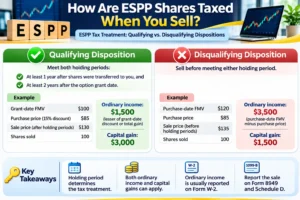
The IRS distinguishes between two types of dispositions: qualifying and disqualifying dispositions.
What Is a Qualifying Disposition?
A qualifying disposition occurs when an employee satisfies both holding-period requirements:
- The shares are sold more than two years after the option grant date.
- The shares are sold more than one year after the stock transfer date (generally the purchase date).
Both conditions must be satisfied.
For a qualifying disposition, ordinary compensation income is generally the lesser of:
- The difference between the stock’s fair market value on the grant date and the option purchase price.
- The difference between the stock’s fair market value at the time of sale and the purchase price.
Any additional gain is generally treated as capital gain.
The relevant rules are explained in IRS Publication 525.
Internal Revenue Service+1
What Is a Disqualifying Disposition?
A disqualifying disposition occurs when an employee sells the ESPP shares before meeting both required holding periods.
In this situation, the tax treatment is different.
Generally, the difference between the stock’s fair market value on the purchase date and the amount paid for the shares is treated as ordinary compensation income, subject to the applicable rules.
Any remaining gain or loss is generally treated as capital gain or loss.
For example:
- Purchase-date market price: $100
- Employee purchase price: $85
- Sale price: $110
The $15 difference between the purchase-date market value and purchase price is generally ordinary compensation income.
The additional $10 gain is generally capital gain.
The employer should generally report the applicable compensation income on Form W-2.
Does the ESPP Discount Appear on Form W-2?
For a disqualifying disposition, the employer generally reports the applicable ordinary compensation income in Box 1 of Form W-2.
For a qualifying disposition, the employer generally does not have the same wage-reporting requirement for the Section 423 compensation amount.
Employees should also review Form 1099-B from their brokerage.
One common tax-filing issue is that the cost basis reported on Form 1099-B may not include the compensation income already recognized.
You may need to adjust the basis using Form 8949 to avoid reporting the same economic gain twice.
For additional guidance, see the IRS Instructions for Form 8949 and Publication 525.
Internal Revenue Service
What Happens to Your ESPP Discount If You Leave Your Job?
Leaving an employer does not always mean your ESPP contributions or purchased shares are treated the same way.
The outcome depends on when you leave and the specific terms of your company’s plan.
Consider these situations:
Before the purchase date: If you leave employment before the purchase date, your participation may end, and accumulated payroll contributions may be refunded according to the plan rules.
After the purchase date: Shares that have already been transferred to you generally remain yours. Leaving the company does not automatically cancel your ownership.
Before meeting the holding period: You can generally sell your shares, but doing so may result in a disqualifying disposition and different tax treatment.
Check your plan documents for termination dates, contribution refunds, and any special provisions concerning employment termination.
Is a Higher ESPP Discount Always Better?
A higher ESPP discount can make a plan more attractive, but it should not be the only factor in your decision.
Employees should consider the following:
- Discount percentage: Compare the advertised discount with other available employer plans.
- Lookback provision: Determine whether the company uses the lower grant-date or purchase-date stock price.
- Stock performance: Review the company’s financial position and historical stock-price movements.
- Contribution limits: Check how much of your salary can be allocated to the plan.
- Selling restrictions: Understand when you can sell purchased shares.
- Tax implications: Consider the difference between qualifying and disqualifying dispositions.
- Investment concentration: Avoid putting too much of your financial portfolio into the same company that provides your employment income.
For example, if your salary and a large portion of your investments depend on the same company, a decline in its financial performance could affect both your employment and investment portfolio.
An ESPP discount can provide a financial advantage, but it does not eliminate investment risk.
Frequently Asked Questions About ESPP Discounts
1. What is a typical ESPP discount?
A 15% discount is common among employer-sponsored ESPPs. However, some companies offer 5% or 10%, while others provide different pricing arrangements. The actual discount depends on the employer’s plan.
2. Is a 15% ESPP discount good?
A 15% ESPP discount is generally attractive because employees can purchase shares below their market value. It can become even more valuable when combined with a lookback provision, although stock-price declines and taxes can affect the final return.
3. How does a 15% ESPP discount with a lookback work?
The plan compares the stock price on the grant date with the price on the purchase date. It selects the lower price and applies the 15% discount. For example, if the two prices are $50 and $80, the employee purchases shares for $42.50.
4. Can an ESPP discount be more than 15%?
Some employer plans may offer arrangements with discounts exceeding 15%. However, plans seeking Section 423 tax qualification must satisfy the statutory purchase-price requirements, including the applicable 85% pricing threshold. Other plan provisions must also meet the law.
5. Do you pay taxes on an ESPP discount immediately?
For a qualifying Section 423 plan, employees generally do not pay federal income tax when shares are purchased. Tax consequences generally arise when the shares are sold or otherwise disposed of. Non-Section 423 plans may have different tax treatment.
6. Can you sell ESPP shares immediately?
Many ESPPs allow employees to sell their shares after the purchase transaction is completed and the shares become available in their brokerage accounts. However, employer-imposed restrictions and securities laws may affect when employees can sell.
An immediate sale may also create a disqualifying disposition for tax purposes.
7. What is the difference between an ESPP discount and a lookback provision?
An ESPP discount is the percentage reduction applied to the applicable stock price. A lookback provision determines which stock price is used to calculate the discounted purchase price, usually the lower of the grant-date and purchase-date prices.
8. Can you lose money with an ESPP?
Yes. Although an ESPP discount reduces the initial purchase price, the company’s stock can decline after the shares are purchased. If the market price falls below your purchase price, you may experience an investment loss.
Conclusion
An ESPP discount allows employees to purchase company shares below their fair market value, making Employee Stock Purchase Plans a potentially valuable workplace benefit.
Understanding how the discount is calculated, how lookback provisions work, and how IRS holding-period requirements affect taxation can help employees make better financial decisions.
Before enrolling, review your employer’s ESPP documents carefully. Pay particular attention to the discount percentage, purchase dates, lookback provisions, contribution limits, and selling restrictions.
The most attractive ESPP is not necessarily the one with the highest advertised discount. It is the one whose pricing structure, investment risks, and tax treatment align with your financial goals.