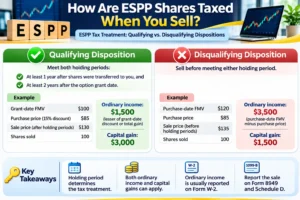
An Employee Stock Purchase Plan (ESPP) allows eligible employees to purchase company shares, often at a discount. One of the most important tax considerations when selling ESPP shares is whether the sale qualifies as a qualifying disposition or a disqualifying disposition.
The difference can significantly affect how much tax you owe and how your stock sale is reported to the Internal Revenue Service (IRS).
An ESPP qualifying disposition occurs when an employee sells shares acquired through a tax-qualified Section 423 Employee Stock Purchase Plan after meeting two specific IRS holding-period requirements:
- At least two years have passed since the offering date.
- At least one year has passed since the stock transfer date (usually the purchase date).
Both conditions must be satisfied for the sale to receive qualifying disposition treatment under Section 423 of the Internal Revenue Code.
Meeting these requirements may allow employees to receive more favorable tax treatment on the discount earned through their ESPP. However, qualifying treatment does not mean the entire profit is tax-free or automatically taxed at the long-term capital gains rate.
Understanding the distinction between ordinary income and capital gains is essential before deciding when to sell ESPP shares.
This guide explains the IRS holding-period rules, tax calculations, reporting requirements, common mistakes, and practical examples for U.S. employees.
How Does an ESPP Qualifying Disposition Work?
To understand a qualifying disposition, it helps to understand how an ESPP works.
A Section 423 ESPP generally allows employees to contribute a portion of their eligible compensation toward purchasing company stock. The company may offer shares at a discount, commonly through an offering period that ends on a purchase date.
For example:
- An employee joins an ESPP on January 1, 2024.
- The company grants an option to purchase shares at a discounted price.
- The employee purchases shares on July 1, 2024.
- The employee holds the shares until January 2, 2026.
- The employee sells the shares after satisfying both IRS holding-period requirements.
If the employee meets the applicable requirements and the plan qualifies under Section 423, the sale can receive qualifying disposition treatment.
The important point is that the employee must measure the holding period from two different dates: the option grant date and the stock transfer date.
The IRS explains these requirements in Publication 525, Taxable and Nontaxable Income and its guidance on Section 423 employee stock purchase plans.
What Are the Two IRS Holding-Period Requirements?
The IRS requires employees to satisfy two holding periods before selling ESPP shares as a qualifying disposition.
Both conditions must be met. Meeting only one requirement is not sufficient.
1. Hold the Shares for at Least Two Years From the Grant Date
The first requirement is that the employee must not sell the shares before the end of the two-year period beginning on the date the option was granted.
The grant date is generally the date the employee receives the option under the ESPP. In many plans, this is the beginning of the offering period.
For example:
- Option grant date: January 1, 2024
- Two-year anniversary: January 1, 2026
- Required holding period: Two years from the grant date
Selling before the applicable two-year period has expired can result in a disqualifying disposition, even if the employee has already owned the shares for more than one year.
This is particularly important for ESPPs with lookback provisions, where the purchase price may be based on the stock’s value at the beginning of the offering period or the purchase date, whichever is lower.
2. Hold the Shares for at Least One Year From the Transfer Date
The second requirement is that the employee must hold the purchased shares for at least one year after the shares are transferred to them.
This date is generally associated with the purchase or exercise of the ESPP option, but employees should verify the actual stock transfer date.
For example:
- Stock transfer date: July 1, 2024
- One-year anniversary: July 1, 2025
- Required holding period: One year from the transfer date
Selling before the one-year period expires will generally result in a disqualifying disposition, even if the employee has already satisfied the two-year grant-date requirement.
Understanding Both Requirements Together
The following table explains how the two holding periods work.
| Requirement | Starting date | Minimum holding period |
| Grant-date requirement | Option grant date | 2 years |
| Transfer-date requirement | Stock transfer date | 1 year |
Important: The employee must satisfy the later of these two deadlines.
For example, suppose an employee receives an option on January 1, 2024, and purchases shares on July 1, 2024.
- Two-year grant-date deadline: January 1, 2026.
- One-year transfer-date deadline: July 1, 2025.
The employee must wait until the two-year requirement has also been satisfied. Therefore, January 2026 is the relevant deadline.
The IRS confirms that the holding-period requirement is satisfied when the employee does not sell until the end of the later of the one-year period after the stock transfer or the two-year period after the option grant. See the IRS stock options FAQ.
How to Calculate Your ESPP Qualifying Disposition Date
Calculating your qualifying disposition date is relatively straightforward once you have the correct grant and transfer dates.
Use the following steps:
Step 1: Find your option grant date.
Check your ESPP account, offering documents, or Form 3922. Identify the date when the option was granted.
Step 2: Add two years to the grant date.
This gives you the end of the first required holding period.
Step 3: Find your stock transfer date.
Check Form 3922, especially Box 7, which identifies the date legal title was first transferred.
Step 4: Add one year to the transfer date.
This gives you the end of the second required holding period.
Step 5: Compare both dates.
The later deadline determines when you can generally sell your shares and satisfy the qualifying disposition holding-period test.
Example: Calculating the Qualifying Disposition Date
Suppose an employee participates in a company ESPP with the following details:
| Detail | Date |
| Option grant date | March 15, 2024 |
| Stock purchase/transfer date | September 15, 2024 |
| Two-year grant-date anniversary | March 15, 2026 |
| One-year transfer-date anniversary | September 15, 2025 |
The later date is March 15, 2026.
Therefore, the employee must wait until the applicable two-year period has expired before selling the shares to meet the qualifying disposition holding-period test.
Practical tip: Do not rely only on the date shown in your brokerage account. Check your employer’s ESPP records and Form 3922 to confirm the dates associated with each share lot.
Qualifying Disposition vs. Disqualifying Disposition
An ESPP sale generally falls into one of two categories: qualifying disposition or disqualifying disposition.
The difference is primarily based on whether the employee meets the IRS holding-period requirements.
| Feature | Qualifying disposition | Disqualifying disposition |
| Two-year grant-date requirement | Satisfied | Not satisfied |
| One-year transfer-date requirement | Satisfied | Not satisfied |
| Ordinary income calculation | Special Section 423(c) rule, when applicable | Generally based on purchase-date fair market value minus purchase price |
| Capital gains | Remaining gain or loss | Remaining gain or loss |
| Tax treatment | May reduce ordinary income recognition | Generally recognizes more compensation income |
What Is a Disqualifying Disposition?
A disqualifying disposition occurs when an employee sells ESPP shares before satisfying both required holding periods.
For example, suppose an employee receives an option on January 1, 2024, purchases shares on July 1, 2024, and sells them on November 1, 2024.
The employee has not held the shares for one year after the transfer date or two years after the grant date.
As a result, the sale is a disqualifying disposition.
A disqualifying disposition does not mean the employee loses the ESPP discount. It means the discount and any additional gain are generally taxed under different rules.
The IRS explains that ordinary income for a disqualifying disposition is generally the difference between the stock’s fair market value on the exercise date and the purchase price. Any remaining gain or loss is treated as a capital gain or loss.
Read the IRS explanation in Publication 525, Employee Stock Purchase Plan.
How Are ESPP Qualifying Dispositions Taxed?
One of the biggest advantages of a qualifying disposition is the potential for more favorable tax treatment of the ESPP discount.
However, the IRS does not treat the entire profit as capital gains.
Instead, the tax calculation may involve two components:
- Ordinary income (compensation income).
- Capital gain or capital loss.
The amount of ordinary income depends on the relationship between the option price, grant-date fair market value, and selling price.
1. Ordinary Income on a Qualifying Disposition
Under Section 423(c), when the option price was below the stock’s fair market value at the grant date (but not less than 85% of that value), the ordinary income is generally the lesser of:
- The grant-date fair market value minus the option price.
- The selling-date fair market value minus the option price.
In simple terms, the IRS limits the ordinary income component to the smaller of these two amounts.
This rule is particularly important for ESPPs that offer a discount or use a lookback provision.
2. Capital Gains on a Qualifying Disposition
After determining the ordinary income component, any remaining gain is generally treated as capital gain.
The adjusted tax basis is calculated by adding the ordinary income recognized to the original purchase price.
The formula is:
Adjusted Cost Basis = ESPP Purchase Price + Ordinary Income Recognized
Then:
Capital Gain or Loss = Sale Proceeds − Adjusted Cost Basis
If the shares are sold for more than the adjusted basis, the difference is generally a capital gain. If they are sold for less, the difference is generally a capital loss.
3. Is the Capital Gain Long-Term?
The ESPP qualifying disposition holding period and the general long-term capital gains holding period are separate tax concepts.
For regular federal capital gains treatment, stock generally must be held for more than one year.
An ESPP qualifying disposition already requires a holding period of at least one year from the transfer date and two years from the grant date. Consequently, a sale satisfying these conditions will generally also qualify for long-term capital gain treatment for any capital gain component.
Long-term capital gains are generally taxed at federal rates of 0%, 15%, or 20%, depending on taxable income and filing status.
Additional taxes, such as the 3.8% Net Investment Income Tax (NIIT), may apply to certain taxpayers.
For current guidance, consult the IRS resources on capital gains and losses.
ESPP Qualifying Disposition Tax Calculation: Practical Example
Let’s consider a practical example to understand how the IRS tax rules work.
Suppose an employee purchases 100 shares through a Section 423 ESPP.
The stock information is:
| Detail | Amount |
| Grant-date fair market value | $25 |
| ESPP purchase price | $20 |
| Purchase-date fair market value | $23 |
| Selling price per share | $30 |
| Number of shares | 100 |
| Total purchase cost | $2,000 |
| Total selling proceeds | $3,000 |
Assume the employee satisfies both holding-period requirements.
Step 1: Calculate the Grant-Date Discount
Grant-date fair market value: $25
Purchase price: $20
Grant-date discount:
$25 − $20 = $5 per share
For 100 shares:
$5 × 100 = $500
Step 2: Calculate the Gain at the Time of Sale
Selling price: $30
Purchase price: $20
Total gain:
($30 − $20) × 100 = $1,000
Step 3: Determine Ordinary Income
The IRS requires the lesser of:
- Grant-date fair market value minus purchase price: $5 per share.
- Selling-date fair market value minus purchase price: $10 per share.
The smaller amount is $5 per share.
Therefore:
$5 × 100 = $500 ordinary income.
Step 4: Calculate Capital Gain
Total sale proceeds: $3,000
Original purchase cost: $2,000
Ordinary income: $500
Adjusted cost basis:
$2,000 + $500 = $2,500
Capital gain:
$3,000 − $2,500 = $500
Final ESPP tax breakdown
Ordinary income
$500
Capital gain
$500
Total economic gain
$1,000
Total sale proceeds
$3,000
Illustrative example before applicable income taxes, capital gains taxes, and transaction costs.
This example follows the calculation in IRS Publication 525, Example 10. The ordinary income is reported as compensation, while the remaining $500 is treated as capital gain.
What Happens If You Sell ESPP Shares Before the Holding Period?
Selling ESPP shares before meeting both IRS holding-period requirements results in a disqualifying disposition.
The ordinary income calculation is generally different from the calculation for a qualifying disposition.
For a disqualifying disposition, the ordinary income amount is generally:
Ordinary Income = Purchase-Date Fair Market Value − ESPP Purchase Price
This amount is generally recognized even if the employee sells the shares for less than the purchase-date fair market value.
Let’s understand this with an example.
Suppose an employee has the following ESPP information:
| Detail | Amount |
| Grant-date stock value | $22 |
| Purchase-date stock value | $23 |
| ESPP purchase price | $20 |
| Selling price | $30 |
| Shares purchased | 100 |
The employee sells the shares only six months after purchasing them.
Because the holding-period requirements are not satisfied, the sale is disqualifying.
Step 1: Calculate Ordinary Income
Purchase-date fair market value: $23
Purchase price: $20
Ordinary income per share:
$23 − $20 = $3
Total ordinary income:
$3 × 100 = $300
Step 2: Calculate Adjusted Cost Basis
Original purchase price:
$20 × 100 = $2,000
Add ordinary income:
$2,000 + $300 = $2,300
Step 3: Calculate Capital Gain
Total sale proceeds:
$30 × 100 = $3,000
Adjusted cost basis:
$2,300
Capital gain:
$3,000 − $2,300 = $700
| Tax category | Amount |
| Ordinary income | $300 |
| Capital gain | $700 |
| Total gain | $1,000 |
The $300 is generally treated as compensation income, while the remaining $700 is a capital gain.
If the shares are held for one year or less after the relevant acquisition date, the capital gain will generally be short-term and taxed at ordinary income tax rates.
This example follows IRS Publication 525, Example 11.
How Do ESPP Lookback Provisions Affect Qualifying Dispositions?
A lookback provision is a feature included in many ESPPs that allows employees to purchase shares at a price based on the lower of the stock’s value at the beginning of the offering period or on the purchase date.
For example:
- Stock price at grant date: $30
- Stock price at purchase date: $25
- ESPP discount: 15%
If the plan applies a 15% discount to the lower price, the purchase price would be:
$25 × 85% = $21.25
The employee purchases shares at $21.25 even though the stock is worth $25 on the purchase date.
A lookback provision can make an ESPP more valuable because employees may benefit from both the plan discount and an increase in the stock price during the offering period.
However, lookback provisions also make the tax calculation more important.
For qualifying dispositions, the grant-date value and option price can determine the ordinary income component under Section 423(c).
For disqualifying dispositions, the purchase-date fair market value is generally used to calculate ordinary income.
Important: The exact calculation depends on the plan’s option pricing terms, including whether the purchase price was fixed or determinable at grant.
What Is Form 3922 and Why Is It Important?
Form 3922, officially called Transfer of Stock Acquired Through an Employee Stock Purchase Plan Under Section 423(c), is an important tax document for ESPP participants.
Your employer or its transfer agent generally provides this form when it records the first transfer of legal title to shares acquired through an applicable Section 423 ESPP option.
Form 3922 helps employees identify the dates and stock values needed to calculate their ESPP tax obligations.
Important Boxes on Form 3922
| Form box | Information provided |
| Box 1 | Option grant date |
| Box 2 | Option exercise date |
| Box 3 | Fair market value on grant date |
| Box 4 | Fair market value on exercise date |
| Box 5 | Purchase price per share |
| Box 6 | Number of shares transferred |
| Box 7 | Date legal title was first transferred |
| Box 8 | Exercise price determined as if exercised on the grant date, when applicable |
How to Use Form 3922 to Track Your Holding Period
Employees can use Form 3922 to determine whether they have met the two-year and one-year holding requirements.
For example:
- Use Box 1 to identify the grant date.
- Use Box 7 to identify the first transfer date.
- Calculate two years from the grant date.
- Calculate one year from the transfer date.
- Compare both dates before selling the shares.
Keep Form 3922 with your tax records because your brokerage account may not provide all the information needed to calculate the correct tax basis.
You can access the official document here: IRS Form 3922.
How to Report an ESPP Qualifying Disposition on Your Tax Return
After selling ESPP shares, employees must report the transaction on their federal income tax return.
The reporting process generally involves reporting any compensation income and the capital gain or loss from the stock sale.
1. Report Ordinary Income
For a qualifying disposition involving a discounted option, the ordinary income amount is generally reported as compensation.
Your employer or former employer should generally include this amount in Box 1 of Form W-2.
If the employer does not provide Form W-2 or does not include the amount in Box 1, the IRS instructs taxpayers to report the income on Schedule 1 (Form 1040), line 8k.
Do not assume that your employer has automatically reported the correct amount. Review your W-2 and ESPP transaction records.
2. Report Capital Gains or Losses
The capital gain or loss portion is reported on:
- Form 8949: Sales and Other Dispositions of Capital Assets.
- Schedule D (Form 1040): Capital Gains and Losses.
You generally calculate your capital gain or loss using the adjusted cost basis, which includes any ordinary income already recognized.
This adjustment helps prevent the same economic gain from being taxed twice.
3. Check Your Form 1099-B
Your brokerage firm generally issues Form 1099-B when you sell shares through its platform.
It typically reports:
- Sale proceeds.
- Acquisition date.
- Cost basis, where applicable.
- Whether the transaction is short-term or long-term.
However, the cost basis reported by your broker may not include the ESPP compensation income recognized under the tax rules.
This is an important issue because using the unadjusted basis can result in double taxation.
For example, suppose you purchased shares for $2,000 and recognized $500 as ordinary income.
Your adjusted basis is $2,500.
If your broker reports only the original $2,000 purchase price, you may need to adjust the basis on Form 8949 to reflect the additional $500.
The IRS provides detailed instructions in Instructions for Form 8949.
4. Complete Schedule D
After reporting the stock transaction on Form 8949, transfer the applicable totals to Schedule D.
Schedule D helps calculate your overall capital gain or loss for the tax year.
Depending on your other investments, you may have additional transactions, capital losses, or capital gain distributions to include.
Common Tax Mistakes to Avoid With ESPP Qualifying Dispositions
Even when employees understand the holding-period requirements, mistakes can happen when calculating and reporting ESPP income.
Here are some common problems to avoid.
1. Confusing the Grant Date With the Purchase Date
The two-year holding period begins with the option grant date, not the date when the employee purchases the shares.
Using the purchase date for both requirements can lead to an incorrect qualifying disposition date.
Always check your Form 3922 and ESPP offering documents.
2. Selling Shares Too Early
Some employees assume that holding ESPP shares for one year automatically qualifies them for favorable tax treatment.
That is incorrect.
A qualifying disposition requires both the two-year grant-date period and the one-year transfer-date period.
Selling before either period expires generally results in a disqualifying disposition.
3. Ignoring the Cost Basis Adjustment
One of the most common ESPP reporting errors is using the original purchase price as the complete tax basis.
For a qualifying disposition with ordinary income, the basis must generally be increased by the amount included in compensation income.
Failing to make the adjustment may cause part of the same gain to be taxed twice.
4. Assuming Every ESPP Is a Section 423 Plan
Not every employee stock purchase plan automatically qualifies for Section 423 tax treatment.
The plan must satisfy the applicable requirements under the Internal Revenue Code.
Some companies offer nonqualified employee stock purchase arrangements that follow different tax rules.
Employees should confirm whether their plan is specifically intended to qualify under Section 423.
5. Ignoring Individual Share Lots
Employees may purchase ESPP shares several times throughout the year.
Each purchase may have a different grant date, purchase date, purchase price, and holding-period deadline.
For this reason, employees should track each share lot separately.
Selling some shares does not automatically determine the tax treatment of all remaining shares.
6. Assuming a Qualifying Disposition Is Always the Best Financial Decision
Waiting for qualifying disposition treatment may reduce ordinary income in some situations, but it also means continuing to hold company stock.
The stock price could decline while you wait.
For example, an employee might delay selling shares to satisfy the two-year requirement, only to see the stock price fall significantly.
The potential tax benefit should be compared with the investment risk of holding concentrated company stock.
A lower tax bill does not necessarily mean a better financial outcome.
What Happens If the Stock Price Falls Before a Qualifying Disposition?
A qualifying disposition does not guarantee a profit.
Stock prices can increase or decrease between the purchase date and the eventual sale date.
If you sell ESPP shares below your purchase price after meeting the holding-period requirements, the result is generally a capital loss, with no ordinary income under the qualifying disposition loss rule.
For example:
- Purchase price: $50 per share.
- Grant-date fair market value: $55 per share.
- Selling price: $45 per share.
- Number of shares: 100.
The employee purchased shares for $5,000 and sold them for $4,500.
The result is a $500 capital loss, assuming no additional transaction costs or adjustments.
There is no ordinary income because the sale price is below the purchase price.
However, the loss must still be reported under the applicable capital loss rules.
For U.S. federal income tax purposes, capital losses generally offset capital gains. If allowable capital losses exceed capital gains, individuals can generally deduct up to 3,000oftheexcessagainstordinaryincome(1,500 if married filing separately), with unused losses generally carried forward.
See the IRS guidance on Capital Gains and Losses.
Does Leaving Your Job Affect ESPP Qualifying Disposition?
Leaving your employer does not automatically prevent you from receiving qualifying disposition treatment.
However, the employment requirements of Section 423 must also be considered.
Generally, an employee must remain employed by the granting corporation or an eligible related corporation during the period beginning on the grant date and ending on the day three months before the option is exercised.
This is separate from the post-purchase holding-period requirements.
For example, an employee might leave the company after exercising an ESPP option and still satisfy the holding periods by retaining the shares.
However, if the employee leaves before exercising the option, the plan’s termination provisions and the statutory employment requirements may affect whether the option can be exercised under Section 423.
Employees should review their plan documents and termination rules before making decisions.
What Happens If You Inherit ESPP Shares or Die Before Selling?
Section 423 includes a special rule for an employee who dies while still owning ESPP shares.
Under Section 423(c), the qualifying disposition income rule can apply when the employee dies while owning the shares, even if the ordinary holding-period requirements have not been completed.
This does not mean that every inherited ESPP share automatically receives the same tax treatment.
The treatment of inherited property, the deceased employee’s income, estate tax considerations, and the beneficiary’s subsequent sale may involve separate rules.
If an employee dies while holding ESPP shares, the executor or beneficiary should obtain the ESPP records, Form 3922, brokerage statements, and relevant tax documentation.
Professional tax advice is particularly important in this situation.
Can You Sell Some ESPP Shares and Keep the Rest?
Yes. Employees generally do not have to sell all their ESPP shares at once.
You can sell a portion of your shares while keeping the remaining shares invested.
However, the tax treatment depends on the specific shares sold.
For example, suppose you have three ESPP purchase lots:
| Share lot | Grant date | Transfer date |
| Lot 1 | January 2023 | July 2023 |
| Lot 2 | July 2023 | January 2024 |
| Lot 3 | January 2024 | July 2024 |
Each lot has its own qualifying disposition deadline.
Selling Lot 1 may qualify for favorable Section 423 treatment, while selling Lot 3 on the same day may result in a disqualifying disposition.
This is why employees should use specific share identification when selling ESPP stock, where permitted by their brokerage and properly communicated to the broker.
If the shares cannot be adequately identified, the first-in, first-out (FIFO) method generally applies.
You can review the IRS guidance on stock basis and identification in its Stocks, Options, Splits, and Traders FAQ.
Federal and State Tax Considerations for ESPP Qualifying Dispositions
ESPP tax treatment can involve more than federal income tax.
U.S. employees should also consider state and local tax rules.
Federal Income Tax
At the federal level, the ordinary income portion of a qualifying disposition is generally taxed as compensation at applicable ordinary income tax rates.
The remaining capital gain is generally eligible for long-term capital gains treatment if the relevant holding-period requirements are met.
State Income Tax
State income tax treatment varies.
Some states follow federal tax treatment, while others have specific rules concerning stock compensation, income sourcing, and residency.
For employees who move between states during an ESPP offering or holding period, state tax considerations can become more complicated.
Net Investment Income Tax
Certain higher-income taxpayers may also be subject to the 3.8% Net Investment Income Tax (NIIT).
Whether NIIT applies depends on modified adjusted gross income, filing status, and the type of income involved.
The ordinary income portion and capital gain portion should not automatically be treated as having identical tax consequences.
For further information, visit the IRS Net Investment Income Tax page.
Qualifying Disposition Tax Planning: What Should Employees Consider?
Before selling ESPP shares, consider the following practical factors.
1. Confirm your holding-period dates.
Use Form 3922 and your ESPP records to calculate the exact applicable deadlines.
2. Compare the potential tax savings.
Calculate the difference between qualifying and disqualifying disposition treatment.
3. Evaluate the stock’s performance.
Consider whether the potential tax benefit justifies the risk of continuing to hold company shares.
4. Review your overall investment portfolio.
Holding a large percentage of your investments in your employer’s stock can increase financial risk because your employment income and investments may depend on the same company.
5. Check your cost basis.
Make sure your tax records account for any compensation income included in your taxable income.
6. Consider your income tax bracket.
The value of qualifying disposition treatment depends partly on your ordinary income tax rate and applicable long-term capital gains rate.
7. Consult a tax professional when necessary.
Complex situations involving multiple purchase lots, state residency changes, inherited shares, or missing tax documents may require professional assistance.
Frequently Asked Questions About ESPP Qualifying Dispositions
1. What is the holding period for an ESPP qualifying disposition?
The IRS requires employees to hold ESPP shares for at least two years from the option grant date and one year from the stock transfer date. Both requirements must be satisfied.
2. Can I sell ESPP shares after one year?
Yes, you can sell your shares after one year, but that does not automatically make the sale a qualifying disposition. You must also satisfy the two-year holding period from the option grant date.
3. What happens if I sell ESPP shares before two years?
If you sell shares before satisfying both holding-period requirements, the sale generally becomes a disqualifying disposition. The difference between the stock’s fair market value on the exercise date and the purchase price is generally treated as ordinary income.
4. Is an ESPP qualifying disposition tax-free?
No. A qualifying disposition is not completely tax-free. The applicable ordinary income portion is generally taxed as compensation, while the remaining gain may qualify for long-term capital gains treatment.
5. How is ordinary income calculated for a qualifying disposition?
When the ESPP option was granted at a qualifying discount, ordinary income is generally the lesser of the grant-date fair market value minus the purchase price or the selling-date fair market value minus the purchase price.
6. Does Form 3922 show the qualifying disposition date?
No. Form 3922 provides important information, including the option grant date and stock transfer date, but it does not directly identify the qualifying disposition date. Employees must calculate the applicable holding periods themselves.
7. Do I need to report a qualifying disposition on my tax return?
Yes. You generally need to report the ordinary income portion as compensation and the capital gain or loss on Form 8949 and Schedule D, as applicable.
8. Can I make a qualifying disposition if I leave my company?
Yes, potentially. Leaving your employer after exercising the ESPP option does not automatically disqualify the shares. However, the Section 423 employment requirements and your plan’s termination provisions must be considered.
9. Is a qualifying disposition always better than a disqualifying disposition?
Not necessarily. A qualifying disposition may provide more favorable tax treatment, but holding company stock longer exposes you to market risk. A stock price decline could outweigh the potential tax savings.
10. What is the difference between an ESPP qualifying disposition and an ISO qualifying disposition?
Both use the two-year grant-date and one-year post-exercise or transfer holding-period requirements. However, their ordinary income, alternative minimum tax, and cost-basis rules differ. ESPP rules are governed primarily by Section 423, while incentive stock option rules are governed by Section 422.
Conclusion
An ESPP qualifying disposition allows eligible employees to receive potentially favorable tax treatment when selling shares acquired through a Section 423 Employee Stock Purchase Plan.
The most important requirement is understanding the two IRS holding periods: two years from the option grant date and one year from the stock transfer date.
Employees must satisfy both requirements before selling their shares to receive qualifying disposition treatment.
However, meeting the holding periods does not eliminate taxes. The applicable ordinary income portion must still be recognized, and any remaining gain or loss must be calculated using the adjusted cost basis.
Before selling ESPP shares, review Form 3922, verify each share lot’s holding period, and understand the potential federal and state tax consequences.
With proper planning and accurate tax reporting, employees can make better-informed decisions about when to sell their ESPP shares.
Authoritative IRS and Government Resources
The following resources provide additional information about ESPP taxation, holding periods, and federal reporting requirements.
1. IRS Publication 525 – Taxable and Nontaxable Income: Detailed guidance on ESPP ordinary income, qualifying dispositions, disqualifying dispositions, and tax calculations.
2. Internal Revenue Code Section 423: The federal law establishing the requirements for tax-qualified employee stock purchase plans.
3. IRS Form 3922: Official information about stock transfers under Section 423 ESPPs.
4. IRS Section 423 Stock Options FAQ: Explains ESPP tax reporting and holding-period requirements.
5. IRS Instructions for Form 8949: Guidance on reporting stock sales, cost basis, and capital gains or losses.
6. IRS Topic 409 – Capital Gains and Losses: Explains short-term and long-term capital gains and losses.
Disclaimer: This article is for general educational purposes and is not individualized tax, legal, or investment advice. Federal tax treatment depends on the specific ESPP terms and taxpayer circumstances. Consult a qualified tax professional for advice about your situation.