
Introduction
Have you ever added an item to your online shopping cart, calculated the price in your head, and then discovered that the final checkout total was much higher than expected? Sales tax, delivery charges, service fees, handling costs, and other checkout expenses can make it difficult to know what you will actually pay.
In the United States, sales tax rules vary by state, county, city, and sometimes special taxing district. The tax rate may also depend on what you purchase, where the item is delivered, and whether the product or service is taxable. On top of that, retailers may charge shipping fees, payment-related fees, or other disclosed costs that are separate from sales tax.
Understanding sales tax calculations helps shoppers compare prices accurately, identify unexpected charges, and plan their budgets before completing a purchase.
This guide explains how US sales tax works, how to calculate it, which additional fees to watch for, and what to do when your checkout total does not match your expectations.
What Is Sales Tax?
Sales tax is a consumption tax imposed by state and, where authorized, local governments on certain retail sales of goods and services. Retailers generally collect the tax from customers on taxable transactions and send it to the relevant tax authority.
Not every purchase is taxable in every location. States may exempt or treat differently certain groceries, prescription medicines, clothing, digital products, services, and other categories.
For example, Florida has a general state sales tax rate of 6%, with certain exceptions, and many counties impose an additional discretionary sales surtax. The applicable total can therefore differ by location and transaction. See the Florida Department of Revenue’s sales and use tax guidance.
Sales tax is not the same as a retailer’s service fee or shipping charge. A tax is imposed under applicable law, while a business fee is a charge imposed under the seller’s terms, subject to relevant legal requirements.
How Are Sales Tax Calculations Made?
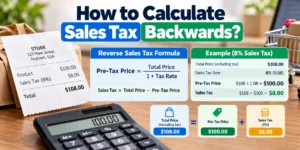
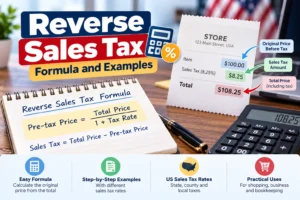
The basic formula is:
Sales tax = Taxable purchase amount × Applicable tax rate
To calculate the total price:
Final total = Taxable purchase amount + Sales tax + Other applicable charges
Suppose you buy a taxable product for $120 and the combined sales tax rate is 8%.
- Item price: $120
- Sales tax rate: 8%
- Sales tax: $120 × 0.08 = $9.60
- Total before other fees: $129.60
This example assumes the entire $120 is taxable and that no other charges apply. Actual transactions may involve discounts, taxable shipping, exempt products, or other rules that change the result.
For quick estimates, use the CalcZest Sales Tax Calculator if the relevant calculator is available on the site, or calculate the tax manually using the formula above.
Why Does Sales Tax Vary by Location?
The United States does not have one nationwide general retail sales tax rate. Some states impose a state-level sales tax and permit additional local taxes. Others do not impose a general statewide sales tax, although other taxes or fees may still apply.
A purchase may be subject to a combination of state, county, city, and special district taxes. The applicable rate can depend on the location where the sale is sourced under that jurisdiction’s rules.
For online orders, the destination where the buyer receives the goods often matters, although sourcing rules and exceptions vary by state and transaction type. Washington, for example, explains that its retail sales tax combines a state portion with a local portion and that the rate is based on where the customer receives the goods. Read the Washington Department of Revenue’s retail sales tax guidance.
This is why an online order delivered to one ZIP code may have a different tax amount from the same product delivered to another ZIP code.
Shopping tip: Use the delivery address you actually intend to use when reviewing an online checkout estimate. A ZIP-code estimate can be useful, but it may not always identify the precise local tax jurisdiction.
Hidden Fees That Can Increase Your Checkout Total
Sales tax is only one part of the final amount. The following charges can make a purchase more expensive than the advertised price.
1. Shipping and delivery charges
Retailers may charge standard shipping, expedited delivery, oversized-item delivery, or special handling fees. Whether shipping charges are taxable depends on the state and the transaction.
For example, Washington generally includes shipping and delivery charges in the selling price for sales tax purposes. Other jurisdictions have different rules or exceptions. See the Washington Department of Revenue’s marketplace seller guidance.
Example: You purchase an item for $80 and pay $10 for shipping. If both amounts are taxable at an 8% rate, the tax is $7.20, making the total $97.20.
If shipping is exempt under the applicable rules, the result may be different.
2. Handling and packaging fees
Some sellers add handling, packaging, or special preparation charges. Depending on state law and the nature of the transaction, these charges may be included in the taxable sales price.
Check whether the charge was disclosed before you placed the order and whether the seller explains what it covers. Do not assume that a separately listed fee is automatically exempt from sales tax.
3. Service and processing fees
Event tickets, reservations, online services, and certain retail purchases may include processing or service fees. The tax treatment depends on the jurisdiction, the type of transaction, and the specific charge.
A service fee is not automatically a tax. Review the checkout breakdown to determine which amount is sales tax and which amount is a business charge.
4. Payment-related fees
Some businesses disclose a surcharge for particular payment methods, such as credit cards. Applicable restrictions, disclosure requirements, and card-network rules can affect whether and how such a charge may be imposed.
A payment surcharge should not be confused with sales tax. If you see an unexpected charge, check the seller’s payment policy and compare the amount with the terms presented before checkout.
5. Subscription renewals and recurring charges
Streaming services, software subscriptions, memberships, and digital platforms may charge recurring fees. Depending on the state, the product or service may be taxable, exempt, or subject to special rules.
A free trial may also convert into a paid subscription if you do not cancel within the required period. Review the renewal date, billing frequency, cancellation process, and any applicable taxes before signing up.
6. Retail delivery and other government-imposed fees
Some jurisdictions impose specific fees on certain deliveries or products. These may appear as separate line items and may have rules different from ordinary sales tax.
For instance, Colorado’s sales tax guidance discusses retail delivery fees and their treatment in determining the taxable purchase price. See the Colorado Department of Revenue Sales Tax Guide.
Always check the name of the charge and the relevant state or local guidance rather than assuming every government-imposed fee is part of the general sales tax rate.
How Discounts, Coupons, and Promotions Affect Sales Tax
Discounts can reduce the amount on which sales tax is calculated, but the result depends on the type of discount and state rules.
Consider a taxable product priced at $100 with an 8% tax rate.
| Purchase scenario | Taxable price | Sales tax | Total |
| No discount | $100.00 | $8.00 | $108.00 |
| $20 seller discount | $80.00 | $6.40 | $86.40 |
The second example assumes the seller discount reduces the taxable selling price. Third-party coupons, manufacturer rebates, gift cards, and loyalty rewards may be treated differently depending on the applicable rules.
Before comparing promotions, check whether the advertised discount is applied before tax, whether shipping is included, and whether minimum-spend requirements apply.
Online Shopping: Who Collects the Sales Tax?
Online shopping has made sales tax more complicated because a retailer may sell to customers in many states without operating a traditional store in each one.
Under state laws adopted following major legal developments, many remote sellers must collect sales tax when they meet the applicable economic or physical presence requirements. Online marketplaces may also be responsible for collecting and remitting tax on qualifying third-party sales.
For example, New York requires marketplace providers to collect and remit state and local sales tax on qualifying taxable sales they facilitate for delivery to New York addresses. The exact obligations depend on the law and transaction. See the New York State Department of Taxation and Finance marketplace guidance.
For shoppers, the practical takeaway is simple: an online retailer or marketplace may collect tax at checkout even when the seller is located in another state.
Do not assume that an online purchase is tax-free simply because the seller has no physical store near you.
What Is Use Tax, and When Might You Owe It?
Use tax generally applies when taxable goods are used, stored, or consumed in a state and the required sales tax was not paid to that state. It is often relevant when a shopper buys an item from an out-of-state seller that does not collect the appropriate tax.
For example, suppose you buy a taxable item for $500 and receive it in a state where the applicable combined rate is 7%. If the seller collects no tax and no exemption applies, the potential use tax would be:
$500 × 7% = $35.
This is a simplified example. A state may allow a credit for qualifying sales tax paid to another state, and other rules may apply.
Washington explains the distinction between sales tax and use tax in its official sales and use tax guidance.
Shoppers should check their state’s instructions if they discover that tax was not collected on a taxable purchase. The obligation and reporting process vary by jurisdiction.
Returns, Refunds, and Sales Tax Adjustments
Returning a product may entitle you to a refund of the sales tax originally paid, but the details depend on the seller’s return policy and applicable law.
Before returning an item, check:
- Whether the product is eligible for a refund.
- Whether the seller charges a restocking fee.
- Whether original shipping charges are refundable.
- Whether sales tax will be refunded along with the item price.
- Whether the refund will go to your original payment method or be issued as store credit.
If a retailer refunds the purchase price but not the tax, ask for an itemized explanation. Some charges may be nonrefundable under the applicable terms, while other amounts may need to be corrected depending on the transaction and local rules.
Keep your receipt and refund confirmation until the transaction is resolved.
How to Check Whether a Checkout Fee Is Legitimate
An unexpected charge is not necessarily unlawful, but shoppers should be able to understand what they are being asked to pay.
Use this checklist before completing a purchase:
- Review the itemized total. Identify the product price, discounts, shipping, sales tax, and separate fees.
- Compare the tax rate. Check the relevant state or local tax authority’s official rate lookup tool.
- Read the seller’s terms. Look for handling fees, subscription renewals, payment surcharges, and cancellation conditions.
- Confirm the delivery address. The applicable tax rate may change when the destination changes.
- Save the receipt. Keep the order confirmation and a screenshot of the itemized charges if you need to question the amount.
- Contact the seller. Ask for an explanation of any charge that was not clear before payment.
- Escalate when appropriate. If the issue remains unresolved, contact your state consumer protection office or relevant tax authority.
When reviewing an unexpected charge, distinguish between a tax calculation error, a disclosed business fee, and a dispute over the seller’s terms. Each may require a different resolution.
Frequently Asked Questions
How do I calculate sales tax quickly?
Multiply the taxable purchase amount by the applicable tax rate expressed as a decimal. For example, $75 at 8% tax is $75 × 0.08 = $6, producing a total of $81 before additional charges.
Is sales tax calculated on shipping?
It depends on state law and the transaction. Some jurisdictions include shipping and delivery charges in the taxable selling price, while others provide exceptions. Check your state’s official tax guidance.
Why is online sales tax different from the tax at a local store?
The delivery location, sourcing rules, local tax rates, product taxability, and transaction details can differ. Even the same product may be taxed differently in different jurisdictions.
Are all checkout fees taxable?
No single rule applies to every fee nationwide. The tax treatment of shipping, handling, service fees, and other charges depends on the state and the type of transaction.
Can I get sales tax refunded when I return an item?
Often, sales tax paid on a qualifying returned item is refunded with the purchase, but the seller’s policy and applicable law matter. Check your receipt and refund statement if the tax is missing.
What should I do if a seller charges the wrong sales tax?
Contact the seller with your receipt and delivery address, and request an itemized explanation or correction. If the issue is not resolved, consult the relevant state tax authority or consumer protection office.
Conclusion
Understanding sales tax calculations helps shoppers avoid surprises and compare the real cost of purchases. The final amount can include state and local sales taxes, shipping, handling, payment-related fees, subscriptions, and other disclosed charges.
The most reliable approach is to calculate tax using the applicable taxable amount and rate, inspect every checkout line item, and verify uncertain charges with official state guidance. Remember that sales tax rules vary by jurisdiction, so an estimate should not be treated as a universal rule for every purchase.
Disclaimer: This article is for general educational purposes and is not legal, tax, or financial advice. Sales and use tax laws vary by state and locality and may change. For a specific transaction, consult the relevant tax authority or a qualified tax professional.