Have you ever received a salary increase and worried that moving into a higher tax bracket would make you pay more tax than you earn? This concern comes from a common misunderstanding about the US federal income tax system.
The United States uses a progressive tax system. It applies different tax rates to different portions of your taxable income. Your marginal tax rate represents the rate on your next dollar of taxable income, while your effective tax rate shows how much federal income tax you pay compared with your overall income.
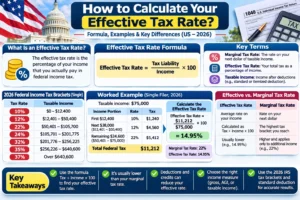
For example, a single taxpayer with $75,000 in taxable income for 2026 falls into the 22% marginal tax bracket. However, the taxpayer does not pay 22% on the entire $75,000. The federal income tax before credits is $11,212, which equals approximately 14.95% of taxable income.
Understanding the difference between marginal vs effective tax rate can help you evaluate salary increases, bonuses, deductions, and other financial decisions.
This guide explains both tax rates with practical 2026 examples, current federal tax brackets, and common situations that affect your tax bill.
What Is a Marginal Tax Rate?
Your marginal tax rate is the federal income tax rate that applies to your next dollar of taxable income. It is generally the highest tax bracket your taxable income reaches.
The US federal income tax system has seven marginal tax rates for 2026:
- 10%
- 12%
- 22%
- 24%
- 32%
- 35%
- 37%
Each rate applies only to the portion of taxable income within its corresponding bracket.
For example, suppose a single taxpayer has $75,000 in taxable income in 2026. The taxpayer falls into the 22% marginal tax bracket because taxable income exceeds $50,400 but does not exceed $105,700.
However, the taxpayer pays:
- 10% on the first $12,400.
- 12% on the next $38,000.
- 22% on the remaining $24,600.
The taxpayer’s marginal rate is 22%, but the taxpayer does not pay that rate on the entire income.
You can review the official thresholds in IRS Revenue Procedure 2025-32, which provides the 2026 federal income tax brackets.
What Is an Effective Tax Rate?
Your effective tax rate measures your total tax liability as a percentage of a selected income amount.
Unlike the marginal rate, which focuses on your next dollar of taxable income, the effective rate gives you an overall view of your tax burden.
The basic formula is:
Effective Tax Rate = (Tax Liability ÷ Income) × 100
For example, suppose your gross income is $80,000 and your federal income tax liability is $9,000.
$9,000 ÷ $80,000 × 100 = 11.25%
Your effective federal income tax rate based on gross income is 11.25%.
The income figure you choose matters. You can calculate an effective rate using gross income, adjusted gross income (AGI), or taxable income. Always identify the denominator when comparing rates.
For a personal income tax comparison, using total or gross income gives you a broader view of the tax burden. Using taxable income shows the tax as a percentage of income after deductions.
Marginal Tax Rate vs Effective Tax Rate: Key Differences
Both rates help explain your federal income tax, but they answer different questions.
| Feature | Marginal Tax Rate | Effective Tax Rate |
| Meaning | Rate on your next dollar of taxable income | Tax liability as a percentage of income |
| Main purpose | Shows the tax impact of additional income | Shows your overall tax burden |
| Calculation | Highest applicable tax bracket | Tax liability ÷ selected income measure × 100 |
| Example | 22% | 14.95% |
| Effect of a raise | Helps estimate tax on additional taxable income | Changes as total tax and income change |
The marginal rate helps you understand how additional income may be taxed. The effective rate helps you understand how much of your income goes toward federal income tax overall.
For many taxpayers, the effective rate is lower than the marginal rate because the progressive tax system applies lower rates to the first portions of taxable income.
2026 Federal Income Tax Brackets
The IRS uses different tax brackets depending on your filing status. The following table shows the 2026 federal income tax brackets for single taxpayers and married couples filing jointly.
| Tax Rate | Single Filers | Married Filing Jointly |
| 10% | 0–12,400 | 0–24,800 |
| 12% | 12,401–50,400 | 24,801–100,800 |
| 22% | 50,401–105,700 | 100,801–211,400 |
| 24% | 105,701–201,775 | 211,401–403,550 |
| 32% | 201,776–256,225 | 403,551–512,450 |
| 35% | 256,226–640,600 | 512,451–768,700 |
| 37% | Over $640,600 | Over $768,700 |
These thresholds apply to taxable income, not directly to gross salary.
For 2026, the standard deduction is:
| Filing Status | Standard Deduction |
| Single | $16,100 |
| Married Filing Jointly | $32,200 |
| Married Filing Separately | $16,100 |
| Head of Household | $24,150 |
Taxpayers generally claim the standard deduction or itemize eligible deductions, subject to applicable rules.
Source: IRS – 2026 Tax Rate Tables and Standard Deductions.
Worked Example: Marginal vs Effective Tax Rate for a Single Filer
Consider a single taxpayer with $75,000 in taxable income for 2026.
The taxpayer reaches the 22% marginal tax bracket.
To calculate the federal income tax, apply each tax rate to the income portion within that bracket.
| Taxable Income Portion | Tax Rate | Tax Amount |
| First $12,400 | 10% | $1,240 |
| Next $38,000 | 12% | $4,560 |
| Remaining $24,600 | 22% | $5,412 |
| Total Federal Income Tax | $11,212 |
The taxpayer’s marginal tax rate is 22%.
Now calculate the effective tax rate using taxable income:
$11,212 ÷ $75,000 × 100 = 14.95%
Final result:
- Taxable income: $75,000
- Federal income tax before credits: $11,212
- Marginal tax rate: 22%
- Effective tax rate on taxable income: 14.95%
This example shows why the marginal tax rate and effective tax rate are not interchangeable.
Worked Example: How a Salary Increase Affects Your Tax Rate
One of the most common tax misconceptions is that a salary increase can push you into a higher tax bracket and leave you with less money.
Let’s examine a simplified example.
Suppose a single taxpayer has $50,000 in taxable income in 2026. The taxpayer remains within the 12% marginal tax bracket.
Now assume taxable income increases to $55,000.
The additional $4,600 above the $50,400 threshold falls into the 22% bracket.
The taxpayer pays:
- 10% on the first $12,400.
- 12% on the next $38,000.
- 22% on the remaining $4,600.
The additional tax on the $4,600 is:
$4,600 × 22% = $1,012
The taxpayer still keeps $3,588 of that additional taxable income before considering other taxes or changes to deductions, credits, and benefits.
The important point: The 22% rate applies only to the portion above the threshold. It does not apply to the taxpayer’s entire $55,000.
A raise can sometimes affect other tax provisions or income-based benefits, but simply entering a higher federal tax bracket does not cause all your income to receive the higher rate.
Worked Example: Marginal and Effective Tax Rates for a Married Couple
Filing status changes the income thresholds that determine your marginal tax rate.
Suppose a married couple files jointly and has $120,000 in taxable income for 2026.
Their federal tax calculation is:
| Taxable Income Portion | Tax Rate | Tax Amount |
| First $24,800 | 10% | $2,480 |
| Next $76,000 | 12% | $9,120 |
| Remaining $19,200 | 22% | $4,224 |
| Total Federal Income Tax | $15,824 |
Calculate the effective tax rate:
$15,824 ÷ $120,000 × 100 = 13.19%
The couple’s marginal tax rate is 22%, while its effective tax rate on taxable income is approximately 13.19%.
This example demonstrates why you should consider filing status when comparing tax rates between individuals or households.
How Do Deductions and Credits Affect These Tax Rates?
Deductions and tax credits can reduce your federal income tax, but they work in different ways.
Tax Deductions Reduce Taxable Income
A deduction reduces the amount of income subject to federal income tax.
For example, a single taxpayer earns $90,000 in 2026 and claims the $16,100 standard deduction.
Taxable income:
$90,000 − $16,100 = $73,900
The taxpayer calculates federal income tax using $73,900 rather than the full $90,000.
A deduction may also reduce the amount of income that falls into a higher marginal tax bracket.
Tax Credits Reduce Tax Liability
Tax credits directly reduce your federal income tax liability when you qualify.
Examples include:
- Child Tax Credit
- Earned Income Tax Credit
- American Opportunity Tax Credit
- Lifetime Learning Credit
- Adoption Credit
Suppose your federal income tax before credits is $10,000 and you qualify for a $1,000 nonrefundable tax credit. If you have enough tax liability to use the full credit, your tax liability falls to $9,000.
Your effective tax rate also decreases.
This is why two taxpayers with the same marginal tax bracket may have different effective tax rates.
See the IRS Credits and Deductions for Individuals for eligibility details and current rules.
Do Bonuses Get Taxed at a Higher Marginal Rate?
Bonuses can increase your taxable income and may push some income into a higher marginal tax bracket.
However, employers may use special federal withholding methods for supplemental wages, including bonuses and commissions.
For example, when the applicable IRS conditions are met, employers may withhold federal income tax from separately identified supplemental wages at a flat 22% rate.
This is a withholding method, not necessarily the employee’s final tax rate.
Your final federal income tax liability depends on your total taxable income, filing status, deductions, credits, and applicable tax rules for the year.
For this reason, do not assume that a 22% bonus withholding rate means every bonus is ultimately taxed at 22%.
Does Your Effective Tax Rate Include Social Security and Medicare?
Not automatically.
The effective federal income tax rate usually measures federal income tax liability against an income amount. It does not necessarily include Social Security and Medicare taxes.
Most employees also pay Federal Insurance Contributions Act (FICA) taxes through their wages.
For 2026, the standard employee rates are:
| Payroll Tax | Employee Rate |
| Social Security | 6.2% |
| Medicare | 1.45% |
| Combined FICA Rate | 7.65% |
Additional Medicare Tax may apply to certain higher-income employees.
If you want to measure your broader tax burden, you can calculate a separate rate that includes applicable payroll taxes. However, label it clearly so readers do not confuse it with the effective federal income tax rate.
See the IRS Employment Taxes guidance for more information.
How to Calculate Both Rates From Your Tax Return
You can use your federal income tax return to estimate your marginal and effective tax rates.
Follow these steps:
1. Find your taxable income.
Review your Form 1040 to identify the taxable income amount.
2. Identify your filing status.
Your filing status determines which federal tax bracket thresholds apply.
3. Find your marginal tax bracket.
Compare your taxable income with the applicable tax brackets for that tax year.
4. Identify your federal income tax liability.
Use the relevant tax liability figure from your completed return. Do not substitute paycheck withholding or your refund amount.
5. Calculate your effective tax rate.
Divide your federal income tax liability by your selected income measure and multiply by 100.
For example, if your federal income tax liability is $11,212 and your gross income is $90,000:
$11,212 ÷ $90,000 × 100 = 12.46%
Your effective tax rate based on gross income is 12.46%.
Use the same tax year and income definition when comparing results. The IRS Forms and Instructions page provides the relevant Form 1040 and instructions.
Common Misconceptions About Marginal vs Effective Tax Rates
1. A Higher Tax Bracket Means You Pay More Tax on All Your Income
Incorrect. Only the income within the higher bracket receives the higher marginal rate.
2. Your Marginal Tax Rate Is Your Actual Tax Percentage
Incorrect. Your marginal rate applies to your next dollar of taxable income. Your effective rate measures your overall tax liability against income.
3. A Bonus Is Always Taxed at 22%
Incorrect. A 22% supplemental wage withholding method may apply, but your final tax liability depends on your complete annual tax situation.
4. Your Paycheck Withholding Equals Your Effective Tax Rate
Incorrect. Withholding represents estimated payments toward your tax liability. Your final tax calculation may produce a refund or additional amount due.
5. Everyone in the Same Tax Bracket Pays the Same Effective Rate
Incorrect. Filing status, deductions, credits, and income sources can produce different effective tax rates for taxpayers in the same marginal bracket.
Frequently Asked Questions
1. What is the main difference between marginal and effective tax rates?
Your marginal tax rate applies to your next dollar of taxable income. Your effective tax rate measures your total tax liability as a percentage of a selected income amount.
2. Is the effective tax rate always lower than the marginal tax rate?
For many taxpayers, yes, because lower tax rates apply to the first portions of taxable income. However, the comparison depends on the tax liability and income measure used.
3. Does moving into a higher tax bracket reduce my take-home pay?
Not simply because of the higher bracket. The higher marginal rate applies only to the additional taxable income within that bracket. Other tax provisions or benefit reductions can affect the overall result.
4. How do I calculate my marginal tax rate?
Find your taxable income and filing status, then identify the highest federal tax bracket your taxable income reaches.
5. How do I calculate my effective tax rate?
Divide your federal income tax liability by your chosen income measure, such as gross income or AGI, and multiply by 100.
6. Do marginal and effective tax rates include state taxes?
Not when you calculate federal income tax rates alone. State and local income taxes require separate calculations. You can calculate a combined rate if you include those liabilities and clearly define the income denominator.
7. Can deductions change my marginal tax rate?
Yes. Deductions can reduce taxable income and may move some income into a lower marginal bracket.
8. Why do two people earning the same salary have different effective tax rates?
They may have different filing statuses, deductions, tax credits, income sources, and other tax circumstances. These differences can change their final federal income tax liabilities.
Conclusion
Understanding marginal vs effective tax rate helps you make better financial decisions and avoid common misunderstandings about the US tax system.
Your marginal tax rate shows how the government taxes your next dollar of taxable income. Your effective tax rate shows how much federal income tax you pay compared with your overall income.
The key point is simple: entering a higher tax bracket does not mean the government applies that higher rate to all your income.
When comparing tax rates, consider your filing status, taxable income, deductions, credits, and the tax year. Use the correct federal tax brackets and calculate your effective rate with a clearly defined income measure.
Disclaimer: This article provides general educational information and does not constitute tax, legal, or financial advice. Actual federal income tax liability depends on filing status, income sources, deductions, credits, and individual circumstances. Consult the IRS or a qualified tax professional for guidance about your specific situation.