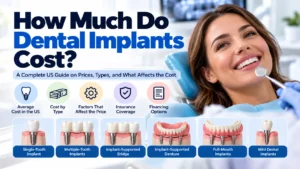

Dental implants are one of the most durable options for replacing missing teeth, but the price can vary significantly from one patient to another. If you are researching dental implant cost in the United States, it is important to understand that there is no single national price for an implant.
The total cost can depend on the number of teeth being replaced, the type of restoration, the condition of your jawbone and gums, the materials used, the dentist or specialist performing the treatment, geographic location, and whether additional procedures are required.
The National Institute of Dental and Craniofacial Research (NIDCR), part of the National Institutes of Health, reports that a dental implant procedure may cost $3,000 or more, including the implant, abutment, and crown. This is a general national reference point rather than a guaranteed price or a quote for an individual patient.
A dental implant is also more than the titanium or other implant body placed into the jaw. The complete restoration may involve the implant, an abutment, and a crown, bridge, denture, or other prosthetic restoration. The U.S. Food and Drug Administration (FDA) explains that dental implant systems are medical devices surgically placed in the jaw to support artificial teeth such as crowns, bridges, or dentures.
This guide explains dental implant cost by type, what is typically included in an implant estimate, which procedures can increase the price, how insurance and government programs may affect your out-of-pocket cost, and what questions to ask before accepting a treatment plan.
Medical disclaimer: This article provides general educational information for U.S. readers and is not medical, dental, financial, or insurance advice. Dental implant treatment is individualized. Only a qualified dentist, prosthodontist, periodontist, or oral and maxillofacial surgeon who evaluates you can determine whether implants are appropriate and what treatment and costs apply to your situation.
How Much Do Dental Implants Cost in the US?
There is no single nationwide price for dental implants.
As a broad reference, the NIDCR’s Oral Health in America report states that each dental implant procedure may cost $3,000 or more, including the implant, abutment, and crown.
However, this figure should not be interpreted as a universal price for every type of implant treatment.
For example, replacing one missing tooth is fundamentally different from replacing an entire arch of teeth. A single-tooth implant may involve one implant and one crown, while a full-arch restoration can involve multiple implants plus a much larger prosthetic restoration.
The American Academy of Periodontology explains that implant treatment can involve single-tooth implants, multiple-tooth implants, and full-mouth implant treatment, with the appropriate approach depending on the patient’s oral condition and treatment needs.
Therefore, when comparing dental implant cost, it is more useful to ask:
- How many teeth need to be replaced?
- How many implants are required?
- What type of restoration will be attached?
- Is bone grafting necessary?
- Is a sinus augmentation necessary?
- Are extractions required?
- What type of implant and restoration materials will be used?
- Is sedation or anesthesia included?
- Are temporary teeth included?
- Are follow-up appointments included?
- Does the quoted price cover the complete treatment or only implant placement?
These questions can explain why two patients may receive very different quotes.
What Is Included in Dental Implant Cost?
Before comparing prices, it is important to understand the components of an implant restoration.
A complete implant treatment may involve several separate stages.
1. Consultation and Examination
Your dentist will typically evaluate your oral health and determine whether an implant is appropriate.
The evaluation may involve:
- Oral examination
- Dental X-rays
- 3D imaging or CBCT when clinically appropriate
- Gum evaluation
- Bone assessment
- Review of medical history
- Treatment planning
The cost of diagnostic imaging can be separate from the surgical fee.
2. Tooth Extraction
If the damaged tooth is still present, it may need to be removed before implant treatment.
An extraction may be a separate charge.
In some situations, an implant can be placed at the same time as extraction, but this depends on the individual clinical circumstances.
3. Implant Placement
The implant body is surgically placed into the jawbone.
The FDA describes the implant body as the portion surgically inserted into the jaw in place of the natural tooth root.
4. Abutment
The abutment connects the implant to the artificial tooth or prosthetic restoration.
5. Crown, Bridge, or Denture
The final restoration is the visible portion that replaces the missing tooth or teeth.
A single missing tooth commonly uses a crown.
Multiple missing teeth may be restored using an implant-supported bridge.
Patients missing many or all teeth may receive an implant-supported denture or full-arch prosthesis.
Because these components can be billed separately, a low advertised implant price may not represent the complete treatment cost.
Dental Implant Cost by Type
The type of restoration is one of the most important factors affecting the overall price.
1. Single-Tooth Dental Implant Cost
A single-tooth implant replaces one missing tooth.
The typical treatment consists of:
- One implant
- One abutment
- One crown
The American Academy of Periodontology describes a single-tooth implant as an implant and crown that replace the missing tooth and its root.
The NIDCR’s national report provides a useful benchmark by stating that each dental implant procedure may cost $3,000 or more, including the implant, abutment, and crown.
However, the final price for an individual patient can be higher if additional treatment is needed.
For example, the patient may require:
- Tooth extraction
- Bone grafting
- Gum treatment
- Temporary restoration
- Additional imaging
- Sedation
- Treatment for periodontal disease
A single implant is therefore not always a simple “implant plus crown” calculation.
2. Multiple-Tooth Dental Implant Cost
Replacing several missing teeth generally costs more than replacing one tooth because the treatment can involve multiple implants and a larger prosthetic restoration.
However, the cost does not necessarily increase by simply multiplying the single-tooth price by the number of missing teeth.
For example, a patient missing three adjacent teeth might be treated with an implant-supported bridge rather than three completely independent implants and three individual crowns.
The American Academy of Periodontology notes that multiple-tooth implant treatment can use implants, abutments, and a prosthetic bridge to replace several teeth.
This means the treatment design can have a major effect on total cost.
Factors affecting multiple-tooth implant cost include:
- Number of missing teeth
- Number of implants required
- Implant location
- Bone availability
- Type of bridge
- Crown material
- Need for grafting
- Need for periodontal treatment
- Laboratory fees
- Temporary restoration requirements
A detailed written treatment plan is therefore more useful than comparing an advertised “price per implant.”
3. Implant-Supported Bridge Cost
An implant-supported bridge can replace several missing teeth using implants as anchors.
Unlike a conventional tooth-supported bridge, the implants provide support rather than relying entirely on neighboring natural teeth.
This can change the treatment design and overall price.
For example, someone missing three consecutive teeth may potentially receive a bridge supported by two or more implants, depending on the clinical situation.
The cost can include:
- Implant placement
- Abutments
- Bridge fabrication
- Surgical procedures
- Diagnostic imaging
- Temporary restoration
- Final prosthetic placement
The appropriate number of implants is determined by factors such as the patient’s anatomy, bone condition, restoration design, and dentist’s treatment plan.
4. Full-Mouth Dental Implant Cost
Full-mouth implant treatment is substantially different from replacing one missing tooth.
A patient who has lost most or all teeth may receive multiple implants supporting fixed or removable prosthetic teeth.
The American Academy of Periodontology explains that full-mouth implant treatment can involve implants, abutments, and prosthetic teeth.
Because the treatment involves a much larger restoration, the total cost can be considerably higher than the cost of a single implant.
However, it would be misleading to provide one fixed national price for “full-mouth implants.”
The final cost can vary depending on:
- Number of implants
- Upper or lower arch
- Type of prosthesis
- Fixed vs. removable restoration
- Bone condition
- Extractions
- Temporary teeth
- Bone grafting
- Sedation
- Laboratory work
- Specialist involvement
- Geographic location
A full-mouth treatment plan should therefore be evaluated as a complete case rather than using a simple per-implant calculation.
5. Implant-Supported Denture Cost
Implant-supported dentures are another option for patients who are missing many or all teeth.
Instead of relying solely on suction or adhesives, the denture can be supported or retained by dental implants.
The number of implants and the design of the denture can vary.
This means the cost can vary significantly as well.
Possible components include:
- Implant placement
- Abutments or attachment components
- Denture fabrication
- Temporary prosthesis
- Extractions
- Bone grafting
- Imaging
- Follow-up adjustments
An implant-supported denture may therefore have a very different cost from a fixed full-arch restoration.
6. Full-Arch Fixed Implant Restoration
A full-arch fixed restoration replaces an entire upper or lower arch using several implants and a fixed prosthesis.
These treatments are sometimes marketed using terms such as “All-on-4” or similar branded or treatment concepts.
Patients should focus on the actual treatment plan rather than the marketing name.
Important questions include:
- How many implants will be placed?
- What type of prosthesis will be used?
- Is the temporary prosthesis included?
- Is the final prosthesis included?
- What happens if an implant fails?
- Are extractions included?
- Is bone grafting included?
- Are follow-up appointments included?
A fixed full-arch restoration can represent a significant investment, so the patient should understand exactly what the quoted price covers.
7. Mini Dental Implant Cost
Mini dental implants are smaller-diameter implants that may be used in certain clinical situations.
They should not automatically be treated as interchangeable with conventional implant systems.
Whether a mini implant is appropriate depends on the patient’s anatomy, treatment objective, bone condition, restoration, and dentist’s clinical judgment.
A lower advertised price does not necessarily mean a better or more appropriate treatment.
Patients should ask why a particular implant design is being recommended and what evidence and clinical considerations support that choice.
What Factors Affect Dental Implant Cost?
The type of implant restoration is only one part of the equation.
Several other factors can substantially affect dental implant cost.
1. Number of Implants
More implants generally mean more surgical and restorative work.
However, the number required depends on the treatment design.
Replacing four missing teeth does not necessarily mean four implants.
A dentist may recommend an implant-supported bridge using fewer implants, depending on the circumstances.
2. Bone Density and Jawbone Condition
Adequate bone is important for implant placement.
If the jaw does not have enough bone volume or appropriate anatomy, additional procedures may be recommended.
The American Academy of Periodontology notes that adequate bone is important for implant treatment and describes ridge modification as a procedure that can be used when there is insufficient bone.
Bone problems may result from:
- Tooth loss
- Periodontal disease
- Trauma
- Long-term denture use
- Anatomical differences
- Other conditions
If bone augmentation is necessary, it can increase both treatment time and cost.
3. Bone Grafting
Bone grafting may be recommended when there is insufficient bone for implant placement.
A graft may be performed before implant placement or, in selected cases, at the time of implant placement.
The American Academy of Periodontology identifies bone grafting at implant placement and ridge augmentation as procedures that may be used in appropriate cases.
Bone grafting can add:
- Surgical fees
- Graft material costs
- Additional appointments
- Healing time
- Follow-up care
Therefore, a quote for “implant placement” may not include bone grafting unless it is specifically listed.
4. Sinus Augmentation
For implants in the upper back jaw, insufficient bone height can sometimes make implant placement more difficult.
A sinus augmentation, commonly called a sinus lift, may be recommended in certain cases.
The American Academy of Periodontology explains that sinus augmentation can help create additional bone in the upper back jaw when bone quantity is insufficient for implant placement.
Depending on the patient’s situation, the procedure may be performed separately from implant placement or in conjunction with it.
Because it is an additional surgical procedure, it can increase total treatment costs.
5. Tooth Extraction
If a tooth needs to be removed before implant placement, extraction can add to the total price.
A simple extraction and a complex surgical extraction may have different costs.
In some cases, an implant may be placed immediately after extraction.
In other cases, the area may need to heal first.
The treatment approach depends on factors such as infection, bone condition, gum health, and the location of the tooth.
6. Gum Health
Healthy gum tissue is important for implant treatment.
Active periodontal disease may need to be addressed before implant placement.
The American Academy of Periodontology states that healthy gum tissues free of periodontal disease are an important consideration for implant candidacy.
Treatment for gum disease can therefore become an additional cost when it is necessary before implant surgery.
7. Implant Material
Dental implant systems are available in different materials.
The FDA states that most dental implant systems are made from materials such as titanium or zirconium oxide, with other materials also used in some systems.
Material selection should be based on clinical considerations rather than price alone.
The implant manufacturer and specific system can also influence the cost of treatment.
Patients should ask their dentist what implant system is being used and why it was selected. The FDA specifically recommends that patients ask their dental provider about the brand and model of the implant system and keep that information for their records.
8. Crown Material
For a single implant, the crown can be one of the components affecting price.
Different materials and laboratory techniques can have different costs.
Your dentist may discuss options based on:
- Location of the tooth
- Appearance
- Function
- Strength requirements
- Existing teeth
- Bite
- Budget
The cheapest material is not necessarily the best choice for every patient.
9. Dentist or Specialist
Dental implant treatment may involve a general dentist, prosthodontist, periodontist, or oral and maxillofacial surgeon, depending on the case and provider’s training.
The American Dental Association emphasizes that implant treatment should begin with a comprehensive examination and discussion of treatment alternatives based on the patient’s diagnosis, oral health, needs, and preferences.
Provider experience, geographic location, complexity of the case, and the scope of treatment can affect professional fees.
10. Geographic Location
Dental costs can vary considerably across the United States.
The cost of operating a dental practice, local labor costs, facility expenses, competition, and regional market conditions can all affect prices.
A quote in a major metropolitan area may differ significantly from one in a smaller community.
However, patients should not select a provider based solely on the lowest price.
Implant placement is a surgical procedure, and the quality of diagnosis, treatment planning, surgical care, restoration, and follow-up matters.
11. Sedation or Anesthesia
Some patients may need or choose sedation or anesthesia depending on the procedure and their clinical circumstances.
These services can create additional charges.
Ask whether the quoted price includes:
- Local anesthesia
- Oral sedation
- IV sedation
- General anesthesia
- Anesthesia provider fees
- Facility fees
Not every treatment requires the same level of anesthesia.
12. Temporary Teeth
Some implant treatments require temporary teeth while the implant heals.
For example, implant placement can involve a healing period before the final crown or prosthesis is attached.
The American Academy of Periodontology notes that single-tooth implant treatment may involve a healing period of several months before the final restoration is completed.
If temporary teeth are required, ask whether they are included in the quoted treatment price.
13. Laboratory Fees
Dental laboratories create many of the prosthetic components used in implant treatment.
Laboratory costs can include:
- Crowns
- Bridges
- Dentures
- Full-arch prostheses
- Custom abutments
- Digital designs
For complex cases, laboratory costs can represent a significant portion of the total treatment price.
14. Follow-Up and Maintenance
Dental implants are not maintenance-free.
The FDA recommends regular dental visits and careful oral hygiene following implant treatment.
Long-term costs may include:
- Professional cleanings
- Examinations
- X-rays
- Repairs
- Prosthetic replacement
- Treatment of peri-implant problems
The initial implant price should therefore not be considered the complete lifetime cost.
Dental Implant Cost: What Does Insurance Cover?
Dental insurance coverage varies substantially by plan.
Some dental insurance policies may provide benefits toward certain implant-related services, while others may exclude implants or place significant limitations on coverage.
Important policy terms can include:
- Annual maximum
- Deductible
- Coinsurance
- Waiting period
- Missing-tooth clause
- Implant exclusions
- Prosthetic coverage
- Bone graft coverage
- Periodontal coverage
Do not assume that because a plan covers crowns, it automatically covers every component of an implant procedure.
Ask the insurer for a written explanation of benefits or request a predetermination/pre-treatment estimate when available.
Does Medicare Cover Dental Implants?
For most routine dental care, Original Medicare generally does not cover the care, treatment, filling, removal, or replacement of teeth or structures directly supporting the teeth.
CMS states that Medicare has a statutory dental coverage exclusion, although there are specific exceptions for certain dental services that are integral to covered medical treatment.
Some Medicare Advantage plans may provide additional dental benefits beyond Original Medicare.
Therefore, Medicare beneficiaries should check the exact benefits of their Medicare Advantage plan rather than assuming all dental implant treatment is covered.
CMS explains that some Medicare Advantage plans may cover routine and other dental services as an additional benefit.
Does Medicaid Cover Dental Implants?
Medicaid dental coverage for adults varies by state.
Medicaid.gov explains that states have flexibility in determining what dental benefits are provided to adult Medicaid beneficiaries, and there are no federal minimum requirements for adult dental coverage comparable to the mandatory children’s dental benefit.
Therefore, an adult Medicaid recipient in one state may have different dental benefits from an adult Medicaid recipient in another state.
If you have Medicaid, check:
- Your state’s Medicaid dental benefit
- Whether implants are covered
- Whether extractions are covered
- Whether dentures or prostheses are covered
- Annual benefit limits
- Provider-network requirements
- Prior authorization requirements
Do not rely on another state’s Medicaid rules.
Can an HSA or FSA Pay for Dental Implant Treatment?
Potentially, if the expense qualifies as an eligible medical or dental expense under the applicable plan and federal tax rules.
The IRS states that medical expenses can include payments for qualifying services provided by dentists and other medical practitioners, subject to the applicable requirements.
The IRS also explains that qualifying medical and dental expenses can potentially be paid or reimbursed through arrangements such as HSAs and FSAs when the applicable requirements are met.
Patients should confirm eligibility with their HSA/FSA administrator before assuming a particular implant-related expense qualifies.
Are Dental Implants Tax Deductible?
Certain qualifying dental expenses may be included as medical expenses for federal tax purposes, subject to the applicable requirements and limitations.
The IRS states that expenses for the prevention and alleviation of dental disease can qualify as medical expenses.
However, a tax deduction is not the same thing as reimbursement.
You should not assume that the full cost of dental implants automatically produces a tax deduction.
Eligibility can depend on factors including:
- Whether the expense qualifies
- Whether insurance reimbursed part of the cost
- Whether you itemize deductions
- Applicable federal tax limitations
- The year in which the expense was paid
Consult a tax professional for advice about your specific circumstances.
How to Compare Dental Implant Quotes
If you receive two quotes from different dental offices, don’t compare only the headline number.
Instead, request an itemized treatment estimate.
Ask each provider to identify the cost of:
- Consultation
- X-rays
- CBCT/3D imaging
- Extraction
- Implant placement
- Abutment
- Crown
- Temporary restoration
- Bone graft
- Sinus lift
- Sedation
- Laboratory work
- Follow-up visits
Then compare the total treatment plan.
For example, a clinic advertising a very low “implant price” may be quoting only the surgical implant placement.
Another provider may quote the complete treatment, including the implant, abutment, crown, imaging, and follow-up.
The second quote could therefore appear more expensive even if the final out-of-pocket difference is smaller.
Questions to Ask Your Dentist About Implant Cost
Before starting treatment, consider asking:
Treatment questions
- Am I a good candidate for a dental implant?
- What alternatives are available?
- How many implants do I need?
- What type of implant system will you use?
- Why is this treatment recommended?
Cost questions
- Does the quote include the implant?
- Is the abutment included?
- Is the crown included?
- Are X-rays and 3D scans included?
- Are extractions included?
- Is bone grafting included?
- Is sedation included?
- Are temporary teeth included?
- Are follow-up appointments included?
Insurance questions
- Will you submit the claim to my insurance?
- Does my insurance cover any portion of the procedure?
- Is prior authorization required?
- Is there a waiting period?
- What is my annual maximum?
- Is there a missing-tooth limitation?
Long-term questions
- What happens if the implant fails?
- How long is the restoration expected to last?
- What maintenance will I need?
- How much do replacement components cost?
- What follow-up care is included?
How to Potentially Reduce Dental Implant Costs
The goal should not be to find the cheapest implant at any cost. Instead, focus on finding appropriate treatment at a transparent and reasonable price.
Get Multiple Treatment Opinions
For expensive or complex treatment, obtaining a second opinion can help you understand whether the proposed procedure is reasonable.
The ADA specifically encourages patients to ask questions and seek a second opinion if they are uncomfortable with the recommended treatment.
Ask About Dental Schools
NIDCR recommends dental schools as one possible source of lower-cost dental care because dental students can provide treatment under professional supervision.
Availability and eligibility vary by location and school.
Check Dental Insurance
Review your plan before treatment.
Don’t assume the dentist’s estimate is the same as your final insurance responsibility.
Compare Complete Treatment Plans
Compare the entire treatment rather than comparing a single advertised implant fee.
Ask About Financing
Some dental practices offer financing options, although financing can increase the total amount paid because of interest or fees.
Review the financing agreement carefully before signing.
Why Very Low Dental Implant Prices Can Be Misleading
An advertisement might say:
“Dental implants from $999.”
That number may refer to only one component of treatment.
For example, it may exclude:
- Crown
- Abutment
- Bone graft
- Imaging
- Extraction
- Temporary tooth
- Sedation
- Laboratory costs
- Follow-up treatment
This is why consumers should ask for the total treatment cost.
The FDA recommends that patients discuss the potential benefits and risks of implants with their dental provider and determine whether they are an appropriate candidate.
Price should be considered alongside diagnosis, treatment quality, provider qualifications, implant system, restoration quality, and long-term care.
Are Dental Implants Worth the Cost?
Whether dental implants are worth the cost is an individual decision.
The FDA states that dental implants can help restore chewing ability and appearance and can help preserve jawbone and surrounding structures. However, complications can occur, including implant failure that may require additional treatment.
The American Academy of Periodontology also notes that implants can provide an alternative to bridges or removable dentures in appropriate patients.
A patient should therefore consider:
- Oral health
- Number of missing teeth
- Bone condition
- Alternative treatments
- Expected longevity
- Maintenance requirements
- Insurance coverage
- Total out-of-pocket cost
- Personal priorities
There is no single treatment that is ideal for every patient.
Dental Implant Cost vs. Other Tooth Replacement Options
When considering the price of implants, it is useful to compare the entire treatment—not just the initial cost.
Dental Implant
A dental implant replaces the tooth root and supports a crown, bridge, or denture.
Traditional Bridge
A bridge can replace a missing tooth without placing an implant into the jaw, but it may require preparation of supporting teeth.
The American Academy of Periodontology notes that a conventional tooth-supported bridge can require adjacent teeth to be reduced to support the bridge.
Removable Denture
A conventional denture can replace several or all missing teeth without surgically placing implants.
Implant-Supported Denture
This combines implants with a removable prosthesis to improve retention and support.
The best choice depends on the patient’s oral condition, preferences, clinical needs, and budget.
Dental Implant Cost: A Simple Example
Consider two hypothetical patients.
Patient A: One Missing Tooth
Patient A needs one missing tooth replaced.
The treatment may involve:
- Examination
- Imaging
- Implant
- Abutment
- Crown
If no additional procedures are needed, the treatment may be relatively straightforward.
The NIDCR reports that an individual dental implant procedure may cost $3,000 or more when the implant, abutment, and crown are included.
Patient B: Multiple Missing Teeth
Patient B has lost most teeth and needs a full-arch restoration.
The treatment could involve:
- Multiple extractions
- Multiple implants
- Bone grafting
- Temporary teeth
- Abutments
- Final full-arch prosthesis
- Multiple appointments
- Laboratory work
It would therefore be inappropriate to estimate Patient B’s cost by simply multiplying the cost of Patient A’s single implant.
This illustrates why dental implant cost by type can vary so significantly.
Frequently Asked Questions About Dental Implant Cost
How much does a dental implant cost in the US?
The NIDCR’s Oral Health in America report states that each dental implant procedure may cost $3,000 or more, including the implant, abutment, and crown. Actual costs vary based on treatment complexity, location, provider, materials, and additional procedures.
How much does one tooth implant cost?
A single-tooth implant may involve an implant, abutment, and crown. NIDCR provides a national reference of $3,000 or more for a dental implant procedure including those components, but an individual quote can be higher or lower depending on the circumstances.
Is the crown included in the cost of an implant?
Not always. Some dental practices quote the implant surgery separately from the abutment and crown. Always ask whether the quoted price covers the complete restoration.
Does dental insurance cover implants?
Coverage depends on the specific dental insurance policy. Some plans may cover certain implant-related services, while others may exclude implants or impose limitations.
Does Medicare pay for dental implants?
Original Medicare generally does not cover routine dental services involving the care, treatment, removal, or replacement of teeth. Certain exceptions exist for dental services that are integral to covered medical treatment. Some Medicare Advantage plans may provide additional dental benefits.
Does Medicaid pay for dental implants?
Adult dental benefits under Medicaid vary by state. States have flexibility in determining adult dental coverage, so patients should check their state’s Medicaid program.
Can an HSA pay for dental implants?
Potentially. The IRS states that qualifying dental and medical expenses can be eligible for HSA or FSA treatment when applicable requirements are met. Check your plan and IRS rules before using HSA/FSA funds.
Does bone grafting increase dental implant cost?
Yes, if bone grafting is clinically necessary, it can add a separate procedure and associated costs. Bone grafting may be performed before or during implant placement depending on the patient’s condition.
Is a sinus lift included in the implant price?
Not necessarily. A sinus augmentation can be an additional procedure and may be separately priced. Ask your dentist for an itemized estimate.
Why do dental implant prices vary so much?
Prices vary because patients require different numbers of implants, restorations, imaging, surgical procedures, materials, specialist care, and follow-up treatment. Geographic location and practice costs can also affect fees.
Is the cheapest dental implant the best option?
Not necessarily. Implant treatment involves surgery and long-term restoration. Patients should consider diagnosis, provider qualifications, implant system, restoration quality, total treatment cost, and follow-up care rather than selecting a provider based solely on price.
Final Thoughts on Dental Implant Cost
The most important thing to understand about dental implant cost is that there is no universal price that applies to every patient in the United States.
A single-tooth implant is usually a much simpler treatment than replacing an entire arch. Multiple-tooth implants, implant-supported bridges, implant-supported dentures, and full-arch fixed restorations can require different numbers of implants and different prosthetic designs.
The NIDCR provides a useful national reference by reporting that a dental implant procedure may cost $3,000 or more, including the implant, abutment, and crown. However, this should be viewed as general educational information rather than a quote for a particular procedure.
Your total cost may increase if you need:
- Tooth extraction
- Bone grafting
- Ridge modification
- Sinus augmentation
- Gum disease treatment
- Additional imaging
- Temporary teeth
- Sedation
- Specialized laboratory work
- More complex prosthetic restoration
Insurance can also make a significant difference in your out-of-pocket expense. Original Medicare generally excludes most routine dental services, while Medicare Advantage plans may offer additional dental benefits. Adult Medicaid dental coverage varies by state.
If you are considering implants, ask for a complete, itemized treatment plan rather than relying on an advertised “starting price.”
Most importantly, discuss the diagnosis, alternatives, risks, expected benefits, timeline, maintenance, and complete cost with a qualified dental professional. The FDA recommends discussing whether you are a suitable candidate for dental implants and understanding their potential benefits and risks before treatment.
A well-informed decision should consider more than the initial price. The right treatment is the one that is clinically appropriate for your situation, clearly explained, and financially understood before you begin.
Recommended Authority Resources & Internal Linking
For SEO and E-E-A-T, the following authoritative U.S. resources can be linked naturally from relevant sections of the article:
- NIDCR/NIH: Oral Health in America – Dental Implants and Costs — useful for the national $3,000-or-more implant cost reference.
- FDA: Dental Implants: What You Should Know — useful for implant components, candidacy, benefits, risks, and patient questions.
- American Academy of Periodontology: Dental Implant Procedures — useful for implant types, candidacy, bone requirements, and treatment options.
- American Dental Association: ADA Statement on Dental Implant Practices — useful for treatment planning, alternatives, financing discussions, and seeking a second opinion.
- CMS: Medicare Dental Coverage — useful for Medicare coverage information.
- Medicaid.gov: Medicaid Dental Care — useful for explaining differences in adult Medicaid dental benefits by state.
- IRS: Medical and Dental Expenses – Publication 502 — useful when discussing potentially qualifying dental expenses and federal tax treatment.
- HealthCare.gov: Dental Coverage in the Marketplace — useful for explaining Marketplace dental-plan options and waiting periods.